Pros
- Most recognized email marketing brand with 13 million plus users worldwide
- Essentials at $13 per month includes A/B testing email scheduling and 24/7 support
- Drag-and-drop email builder produces professional campaigns without HTML knowledge
- Customer Journey Builder on Standard creates multi-step automated workflows
- Landing page builder included on all plans for lead capture
- Content Optimizer uses AI to improve subject lines and email copy
- Free plan exists though severely limited at 250 contacts and 500 sends
Cons
- Unsubscribed contacts still count toward your billable contact limit unless manually archived
- Pricing scales steeply by contact count with Standard jumping from $20 to $100 at 5,000 contacts
- Free plan reduced to 250 contacts and 500 sends in January 2026 making it impractical
- Multi-step automation locked to Standard at $20 not available on Essentials
- Support only available for first 30 days on the free plan then disappears
- Annual price increases of 15 to 30% reported by existing customers
- Premium at $350 per month is expensive relative to ActiveCampaign and Klaviyo alternatives
Everybody starts with Mailchimp. It’s the email marketing tool your first boss used, your freelancer friend recommended, and your startup co-founder signed up for without researching alternatives. 13 million users didn’t all evaluate 10 platforms first. Most picked Mailchimp because they’d heard of it.
That’s fine at 500 contacts. At 5,000, Standard costs $100 per month. Brevo covers the same volume for roughly $25. At 10,000, you’re paying $150-plus while MailerLite charges $47. The Mailchimp tax is real, and it grows with your list.
Starting Price: $13/mo Essentials (500 contacts) | Free Plan: Yes (250 contacts, 500 sends) | Free Trial: Yes (Essentials and Standard)
What Does Mailchimp Cost?
Mailchimp’s pricing has two dimensions: the plan tier and your contact count. The plan sets the features. The contact count sets the actual price. Most people look at the plan price and miss that it multiplies as their list grows.
Free ($0). 250 contacts. 500 sends per month. 1 user. Mailchimp branding on every email. Support only for the first 30 days. This was 500 contacts and 1,000 sends until January 2026. It’s now a trial in everything but name.
Essentials ($13 per month at 500 contacts). 5,000 sends. 3 users. A/B testing, email scheduling, 24/7 email and chat support. No multi-step automation. At 2,500 contacts, Essentials costs roughly $45. At 5,000, roughly $75.
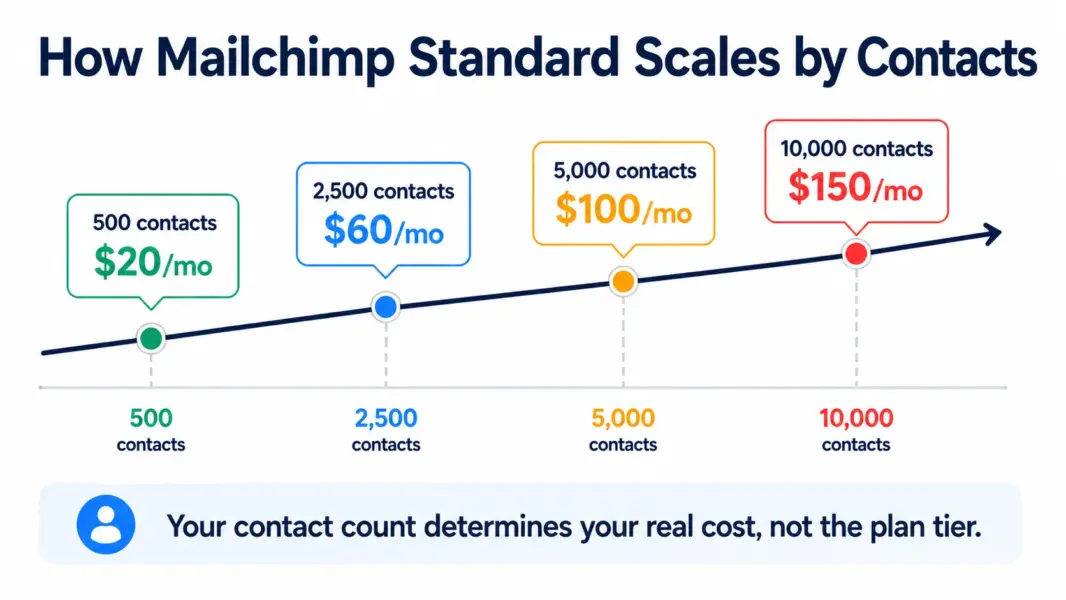
Standard ($20 per month at 500 contacts). 6,000 sends. 5 users. Multi-step Customer Journey Builder, send time optimization, predictive demographics. This is Mailchimp’s recommended plan and where real email marketing begins. At 2,500 contacts, Standard costs roughly $60. At 5,000, roughly $100. At 10,000, roughly $150.
Premium ($350 per month at 10,000 contacts). Unlimited users. Advanced segmentation with unlimited conditions. Multivariate testing. Priority support. Comparative testing (up to 3 variables). At $350 minimum, Premium competes with dedicated platforms like Klaviyo and ActiveCampaign that offer more for less at enterprise scale.
The Billing Trap That Inflates Your Cost
This is the detail that matters more than any feature comparison. Mailchimp counts all contacts toward your billing limit: subscribed, unsubscribed, non-subscribed, and pending. Someone who unsubscribed two years ago still counts. A duplicate contact across two audiences counts twice. According to Mailchimp’s own documentation, the only contacts excluded from billing are those you manually archive, clean, or delete.
Most users don’t know this. They see “2,500 contacts” on their plan and assume that means 2,500 active subscribers. It means 2,500 total contacts, including people who haven’t opened an email in 18 months and people who explicitly unsubscribed. Cleaning your list regularly isn’t optional on Mailchimp. It’s a cost management requirement.
Where Mailchimp Earns Its Spot
The drag-and-drop email builder is genuinely easy. No HTML needed. Templates look professional. A small business owner creates polished campaigns in 30 minutes without design skills.
Customer Journey Builder on Standard creates automated sequences triggered by subscriber actions: welcome series, abandoned cart recovery, re-engagement campaigns, post-purchase follow-ups. It handles the automation most small businesses need without the complexity of dedicated marketing automation platforms.
Brand recognition means deliverability. Mailchimp’s sender reputation and email infrastructure are trusted by inbox providers. For small businesses where emails reaching the inbox matters more than advanced segmentation, that deliverability baseline has value.
When to Switch Away From Mailchimp
Your list passed 2,000 to 3,000 contacts and you’re watching costs climb every month. Brevo charges by sends (not contacts), so a 5,000-contact list costs roughly $25 versus Mailchimp’s $100 on Standard.
You need advanced ecommerce email. Klaviyo’s ecommerce-specific workflows, product recommendation engines, and Shopify integration run deeper than Mailchimp’s for product-based businesses.
You want more value per dollar. MailerLite covers 1,000 subscribers on its free plan (versus Mailchimp’s 250) and grows cheaper at every tier above 2,000 contacts.
Last updated: July 25, 2026
Frequently Asked Questions
How much does Mailchimp cost in 2026?
Essentials starts at $13 per month for 500 contacts. Standard starts at $20 for 500 contacts. Pricing scales by contact count: at 5,000 contacts Standard costs roughly $100 per month. Premium starts at $350 for 10,000 contacts. The free plan covers 250 contacts and 500 sends.
Does Mailchimp charge for unsubscribed contacts?
Yes. All contacts (subscribed, unsubscribed, non-subscribed, pending) count toward your billable limit unless manually archived or deleted. This is the most common unexpected cost on Mailchimp. Clean your list regularly to avoid paying for contacts who will never open your emails.
Is Mailchimp’s free plan still worth it?
Barely. The free plan was reduced to 250 contacts and 500 sends per month in January 2026. Support disappears after 30 days. Mailchimp branding appears on every email. MailerLite’s free plan (1,000 subscribers, 12,000 sends) is significantly more usable for getting started.
Is Mailchimp too expensive?
At 500 contacts, Mailchimp is competitively priced. At 5,000 contacts and above, it becomes expensive relative to Brevo, MailerLite, and ActiveCampaign. The combination of contact-based pricing plus billing for unsubscribed contacts inflates costs beyond what the published tiers suggest.
What is the best Mailchimp alternative?
Brevo for unlimited contacts with send-based pricing. MailerLite for the most generous free plan and cheapest paid tiers. ActiveCampaign for advanced marketing automation. Klaviyo for ecommerce-specific email with deep Shopify integration.
Is Mailchimp good for small business?
For small businesses under 2,000 contacts who want an easy-to-use email tool with a familiar name, yes. The drag-and-drop builder, automations on Standard, and reliable deliverability serve that market well. Above 2,000 contacts, evaluate alternatives that charge less per contact or charge by sends instead.
Related Email Marketing Guides
- ActiveCampaign vs Mailchimp 2026
- MailerLite vs Mailchimp 2026
- Best Free Email Marketing 2026
- Best Email Marketing for Beginners
Mailchimp is the email marketing tool everyone knows. 13 million users, drag-and-drop builder, and enough automation on Standard to run a real email program. The problem in 2026 isn't capability. It's cost. Pricing has risen consistently under Intuit ownership (since 2021), the free plan shrank to near uselessness (250 contacts, 500 sends), and unsubscribed contacts still count toward your bill unless you manually clean them. At 500 contacts, Mailchimp is competitively priced. At 5,000 contacts, Standard costs $100 per month while Brevo covers the same sends for roughly $25. The name recognition is real. The value at scale is not.