Not all free email marketing plans are created equal. Some cap you at 250 contacts, others give you 10,000. Some include automation, others strip it out. The best free email marketing tools depend entirely on your list size, send frequency, and which features you actually need. This guide compares 7 genuinely useful free plans across contact limits, monthly send caps, and the features each one gates, so you pick the most generous fit rather than the most advertised name.
One thing to know upfront: free plans change often, and usually get less generous over time. Several major tools have reduced their free tiers in the past year. The comparison below reflects current limits, and we note exactly what each plan restricts so there are no surprises after you commit.
Free Email Plans Compared at a Glance
The fastest way to choose is to match your contact count and send volume to the right plan. This table shows what each free tier offers before you read the detail on each tool.
| Tool | Free Contacts | Free Monthly Sends | Best For |
|---|---|---|---|
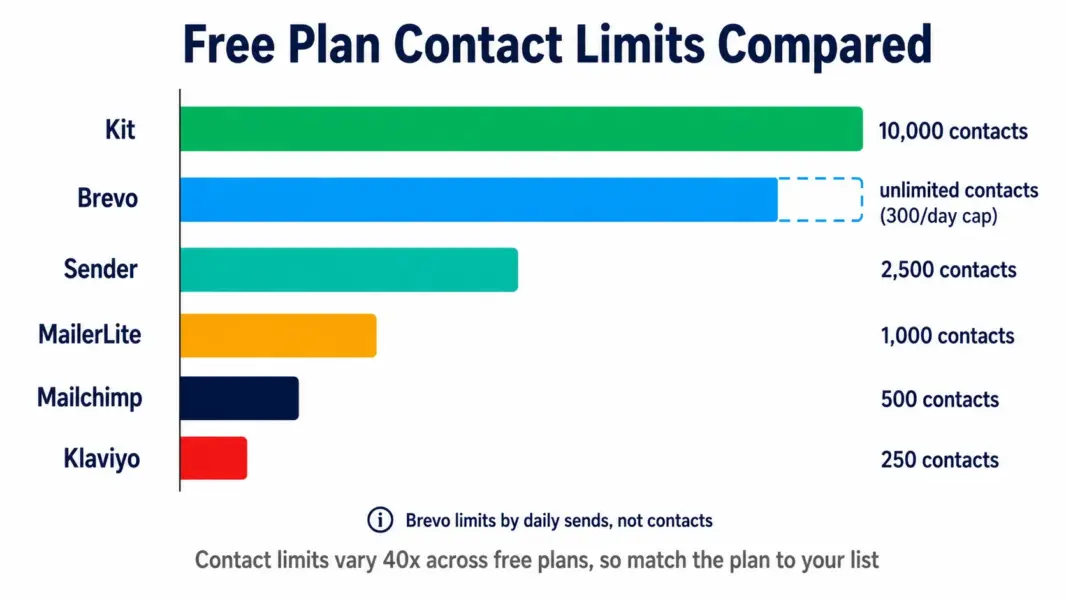
| Brevo | Unlimited contacts | 300/day (~9,000/mo) | Growing lists, low daily volume |
| Sender | 2,500 | 15,000 | Most generous overall |
| MailerLite | 1,000 | 12,000 | Simplicity and ease of use |
| Kit (ConvertKit) | 10,000 | Unlimited | Creators and newsletters |
| Mailchimp | 500 | 1,000 (250/day) | Beginners, brand familiarity |
| HubSpot | Limited (CRM-based) | 2,000 | Built-in CRM users |
| Klaviyo | 250 | 500 | Ecommerce stores testing |
1. Brevo: Best Free Plan for Growing Lists
Brevo (formerly Sendinblue) takes the top spot because its free plan limits by daily sends rather than contact count. You can store an unlimited number of contacts and still send for free, as long as you stay under roughly 300 emails per day. For a business with a growing list but modest send frequency, this model is uniquely generous, since most competitors cap your contacts hard.
The standout is that Brevo’s free tier includes automation, which is rare. You can build multi-step email sequences without paying, something Mailchimp removed from its free plan. The catch: no A/B testing, no landing pages, and Brevo branding on your emails. For startups building a list while sending modestly, Brevo’s free plan stretches further than any contact-capped competitor. See our full Brevo review for details.
2. Sender: The Most Generous Free Volume
Sender offers the most generous straightforward free plan: up to 2,500 subscribers and 15,000 emails per month, with full access to automation and segmentation features that competitors reserve for paid tiers. If your priority is raw free capacity with real features included, Sender delivers more than nearly any other tool.
The combination of a high contact limit, a high send cap, and included automation makes Sender the best choice for small businesses that have outgrown the smallest free tiers but are not ready to pay. Its template library and editor are solid if not flashy. For a business that wants maximum free value without the daily-send constraint Brevo imposes, Sender is the strongest pick.
3. MailerLite: Best Free Plan for Simplicity
MailerLite is the best free plan for users who prioritize ease of use. Its free tier supports up to 1,000 subscribers and 12,000 monthly email sends, with a clean drag-and-drop editor and basic automation. The interface is among the most intuitive in email marketing, making MailerLite ideal for small teams and freelancers who want to start sending quickly without a learning curve.
MailerLite strikes a strong balance between generosity and simplicity. The 1,000-subscriber limit is comfortable for most early-stage lists, and 12,000 monthly sends gives room to email actively. The free plan includes a website builder and landing pages on top of email, which adds value beyond pure sending. For freelancers and small businesses that value a clean experience, MailerLite is the easiest free tool to recommend.
4. Kit (ConvertKit): Best Free Plan for Creators
Kit, formerly ConvertKit, has the most generous contact limit of any major free plan: up to 10,000 contacts on its Newsletter plan. Built specifically for creators like bloggers, YouTubers, podcasters, and artists, Kit prioritizes content-first newsletters with a clean editor and strong deliverability for text-centric emails.
The free plan includes unlimited landing pages and signup forms, essential for list growth, plus native commerce integration that lets you sell digital products and paid newsletter subscriptions even without paying. For creators who need to build a large audience without upfront cost, Kit’s 10,000-contact ceiling is dramatically more generous than the 250-to-2,500 ranges of general tools. The tradeoff is that Kit is optimized for creator newsletters rather than complex business marketing automation.
5. Mailchimp: Best Free Plan for Beginners
Mailchimp remains a strong free option for beginners despite a free plan that has shrunk over time. It supports up to 500 contacts and 1,000 monthly sends, capped at 250 per day. The draw is Mailchimp’s signature ease of use, its broad integration ecosystem, and the brand familiarity that makes it a comfortable starting point for those new to email marketing.
The significant limitation is that Mailchimp removed automation from its free plan, so free users cannot build automated sequences, a feature Brevo and Sender include. Mailchimp’s free tier works for beginners sending simple broadcasts to a small list who value the polished interface and want room to grow into the broader marketing suite. For automation on a free plan, look to Brevo or Sender instead. Compare Mailchimp’s paid tiers in our ActiveCampaign vs Mailchimp comparison.
6. HubSpot: Best Free Plan with Built-In CRM
HubSpot’s free email marketing is part of its free CRM, making it the best choice for businesses that want email and customer relationship management in one platform. The free tier supports around 2,000 email sends per month and connects every email to HubSpot’s contact records, so you see the full history of each contact’s interactions alongside your campaigns.
The value of HubSpot free is the CRM integration, not the email limits, which are modest. For a small business that wants to track contacts, deals, and email in one free system, HubSpot delivers an integrated foundation that standalone email tools cannot. The tradeoff is that HubSpot’s full power lives in paid tiers, and the free email features are basic. Businesses focused purely on email volume get more from Brevo or Sender; businesses wanting CRM plus email get more from HubSpot.
7. Klaviyo: Best Free Plan for Ecommerce Stores
Klaviyo’s free plan supports up to 250 contacts and 500 monthly sends, the most limited on this list by raw numbers. It earns a place because for ecommerce stores, no free plan offers comparable ecommerce-specific power. A small store can test Klaviyo’s Shopify integration, segmentation, and automated flows before committing, something general free tools cannot replicate.
The 250-contact limit means Klaviyo free is strictly for testing, not running a real store. But for an ecommerce founder evaluating whether Klaviyo’s revenue features justify the cost, the free plan is the right way to try before buying. For stores past the testing phase, Klaviyo’s paid plans deliver the ecommerce depth covered in our full Klaviyo review. For non-ecommerce businesses, the tools above offer more generous free limits.
How to Choose the Right Free Email Tool
The right free email marketing tool depends on three factors: your contact count, your send frequency, and whether you need automation on the free plan. Match these to the tool that fits rather than defaulting to the most recognized name.
| Your Situation | Best Free Tool |
|---|---|
| Large list, modest daily sending | Brevo (unlimited contacts, 300/day) |
| Want maximum free volume with features | Sender (2,500 contacts, 15,000 sends) |
| Prioritize ease of use | MailerLite (1,000 contacts, simple) |
| Creator building a large audience | Kit (10,000 contacts, commerce) |
| Beginner wanting brand familiarity | Mailchimp (500 contacts, easy) |
| Need CRM plus email | HubSpot (CRM-integrated) |
| Ecommerce store testing tools | Klaviyo (250 contacts, Shopify) |
A practical tip: choose a tool whose paid plan you would also be happy to upgrade to, since migrating between platforms later costs time and risks deliverability. Starting free on a tool that scales with you avoids a painful migration once you outgrow the free tier.
What Free Email Plans Typically Restrict
Free plans make money by limiting features that growing businesses eventually need. Knowing what is commonly gated helps you anticipate when you will need to upgrade and avoid surprises.
Automation is the most commonly gated feature. Mailchimp removed it from free entirely, while Brevo and Sender include it. If automated sequences matter to you, choose a free plan that includes them rather than discovering the limit after building your list.
Branding appears on most free plans. Brevo, Mailchimp, and others add their branding to free-tier emails. For a professional appearance, removing branding usually requires a paid upgrade. This is rarely a dealbreaker for early-stage sending but matters for established brands.
Advanced features like A/B testing and landing pages are often paid. Free tiers typically exclude A/B testing, detailed analytics, and sometimes landing pages. According to a 2026 analysis of free email plans, automation and A/B testing are the two features most often missing from free tiers, and the most common triggers for upgrading.
Compare email tools by feature
See how the top email marketing platforms stack up on automation, CRM, and pricing in our complete guide.
Last updated: May 31, 2026
Frequently Asked Questions
What is the best free email marketing tool in 2026?
Brevo is the best free email marketing tool for growing lists because it limits by daily sends (around 300 per day) rather than contacts, so you can store unlimited contacts free and it includes automation. Sender is best for maximum free volume at 2,500 contacts and 15,000 monthly sends. The right choice depends on your list size, send frequency, and whether you need automation.
Which free email plan allows the most contacts?
Kit (formerly ConvertKit) allows up to 10,000 contacts on its free Newsletter plan, the highest hard contact limit among major tools. Brevo technically allows unlimited contacts but caps daily sends at around 300. For pure contact capacity, Kit leads for creators, while Brevo leads for businesses that store many contacts but send infrequently.
Do free email marketing plans include automation?
It varies. Brevo and Sender include automation on their free plans, which is increasingly rare. Mailchimp removed automation from its free plan, so free users cannot build automated sequences. If automation matters to you, choose Brevo or Sender rather than Mailchimp. Always verify automation availability before committing, since free-plan features change frequently and usually get less generous.
Is Mailchimp’s free plan still good?
Mailchimp’s free plan remains good for beginners who want a polished, easy interface and brand familiarity, supporting 500 contacts and 1,000 monthly sends. However, it no longer includes automation, which Brevo and Sender offer free. For beginners sending simple broadcasts to a small list, Mailchimp works well. For free automation or larger limits, other tools are more generous.
What is the catch with free email marketing tools?
Free plans typically restrict automation, A/B testing, landing pages, and detailed analytics, and add their branding to your emails. Contact and send limits are the main caps. Free tiers also tend to shrink over time as vendors push upgrades. The catch is rarely hidden cost but rather feature limits that growing businesses eventually hit, triggering a paid upgrade.
Can I run a real business on a free email plan?
Yes, for early-stage businesses with small lists and modest send volume. Brevo, Sender, MailerLite, and Kit free plans can support a real newsletter or small campaign program. You will outgrow free plans as your list grows past their contact limits or you need automation, A/B testing, or branding removal. Choose a free tool whose paid plans you would happily upgrade to.
Which free email tool is best for ecommerce?
Klaviyo’s free plan is best for ecommerce stores testing the platform, supporting 250 contacts with its Shopify and WooCommerce integration, segmentation, and automated flows. The 250-contact limit makes it suitable for testing rather than running a store. For ecommerce email at scale, Klaviyo’s paid plans deliver the depth, while general free tools lack ecommerce-specific revenue features.
Which free email tool has a built-in CRM?
HubSpot offers the best free email marketing with a built-in CRM, connecting every email to contact records so you see full interaction history alongside campaigns. The free email limits are modest at around 2,000 sends per month, but the CRM integration is the value. For businesses wanting email plus customer relationship management in one free system, HubSpot is the strongest choice.
Related Reviews and Guides
- Klaviyo Review 2026
- Brevo Review 2026
- GetResponse Review 2026
- ActiveCampaign vs Mailchimp 2026
- MailerLite vs Mailchimp 2026
- Complete Guide to Email Marketing Software