Pros
- Best-in-class segmentation and automation for ecommerce
- Deep one-click integration with Shopify, WooCommerce, BigCommerce, Magento
- Predictive analytics (expected next order date, customer lifetime value)
- 350+ templates and 80+ automation flow templates
- AI features (Subject Line AI, predictive sending)
- Genuinely useful free plan for testing (250 contacts)
Cons
- Pricing escalates quickly as your contact list grows
- Steep learning curve for marketing newcomers
- Support quality on lower tiers is a documented frustration
- SMS billed separately on top of email plan
- Expensive for non-ecommerce or large lists of non-buyers
This Klaviyo review answers one question: is it worth the price for your ecommerce store? After connecting Klaviyo to a live Shopify store, building abandoned-cart flows, and testing its predictive analytics and AI features, our verdict is clear. Klaviyo is the best email marketing platform for ecommerce brands that treat email as a revenue channel, not just a newsletter. It is also one of the most expensive, and the cost climbs fast as your list grows. This review covers exactly who should pay for it and who should look elsewhere.
What Klaviyo Is Built to Do
Klaviyo is an email and SMS marketing platform built specifically for ecommerce. Founded in 2012 by Andrew Bialecki and Ed Hallen, it has become the default choice for online stores that want to use customer purchase data to drive automated, personalized campaigns. Unlike general email tools that treat ecommerce as one use case among many, every Klaviyo feature assumes you are selling products and want to maximize revenue per subscriber.
The platform centers on three strengths: deep integration with ecommerce platforms, advanced segmentation based on purchase behavior, and predictive analytics that forecast customer actions. Where a generic email tool sends the same campaign to everyone, Klaviyo lets you target customers who bought a specific product 30 days ago, predict when they will reorder, and trigger an email to arrive exactly then.
The Ecommerce Revenue Engine: Where Klaviyo Earns Its Price
Klaviyo’s core value is turning your store’s customer data into automated revenue. The one-click integration with Shopify pulls in historical customer data, order history, and browsing behavior within minutes, then makes all of it available for segmentation and automation. This is the feature that justifies Klaviyo’s premium for serious stores.
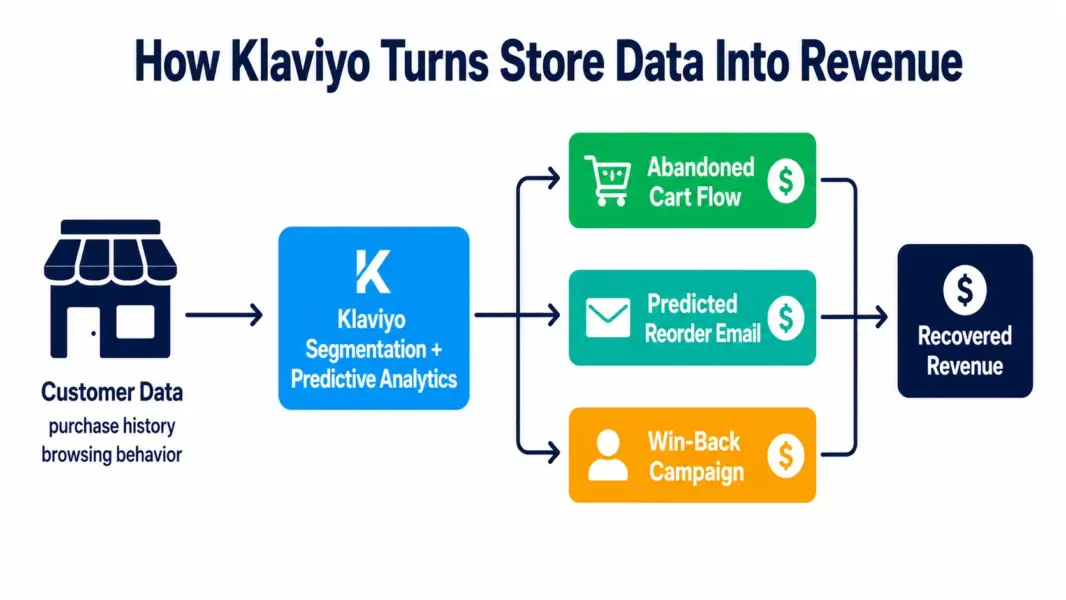
The flows (Klaviyo’s term for automation sequences) are the standout. Pre-built templates cover the revenue-driving sequences every store needs: welcome series, abandoned cart, browse abandonment, post-purchase follow-up, and win-back campaigns. According to Klaviyo’s published customer data, abandoned-cart flows alone routinely recover a meaningful share of otherwise-lost revenue, and the platform makes building them genuinely straightforward despite the underlying sophistication.
The predictive analytics deserve specific mention. Klaviyo analyzes purchase history to forecast each customer’s expected date of next order and predicted lifetime value. You can trigger campaigns based on these predictions, landing a reorder reminder in the inbox exactly when a customer is likely to buy again. No general-purpose email tool matches this depth of ecommerce intelligence.
Segmentation That Goes Deeper Than Competitors
Klaviyo’s segmentation is its second major strength. You can build dynamic segments based on any combination of purchase history, browsing behavior, engagement data, predicted metrics, and custom properties. Segments update in real time as customer behavior changes, so a “high-value repeat buyers” segment always reflects current data without manual maintenance.
This depth is what separates Klaviyo from simpler tools. A store can target customers who bought from a specific collection, spent above a threshold, have not purchased in 60 days, and live in a particular region, all in one segment. For data-driven ecommerce marketers, this granularity directly translates to higher campaign relevance and revenue. For marketers without the time or skill to use it, much of this power goes unused, which is the core of Klaviyo’s value question.
Klaviyo Pricing: Why the Cost Climbs Fast
Klaviyo pricing is based on the number of contacts you store, and it escalates quickly. The free plan supports up to 250 contacts and 500 email sends per month, enough to test the platform but not run a real store. Paid plans begin at $20 per month for up to 500 contacts and scale steeply from there.
| Contacts | Approximate Monthly Cost (Email) |
|---|---|
| Up to 250 | Free (500 sends, Klaviyo branding) |
| 500 | $20 |
| 10,000 | ~$150 |
| 25,000 | ~$400 |
| 250,000 | ~$2,300 |
Two pricing details matter. First, Klaviyo shifted to an “Active Profile” billing model, so you pay based on the contacts you actively market to. Second, SMS is a separate add-on starting around $15 per month and billed on top of your email plan, with per-message rates that add up fast for US audiences. The combined email-plus-SMS cost is where many stores feel the pinch.
This pricing structure creates what some call the “ecommerce tax.” For a store generating revenue from a list of buyers, the cost is justified by the sales Klaviyo drives. For a business with a large list of non-buyers, such as a content brand or service company, you pay for contacts that do not generate the purchase data Klaviyo is built to monetize. See how Klaviyo compares on price in our best free email marketing tools guide.
Where Klaviyo Falls Short
Klaviyo is not the right tool for everyone, and its weaknesses are as clear as its strengths. Knowing them prevents an expensive mismatch.
The learning curve is steep. Klaviyo’s power comes with density. The interface packs in data, and getting full value requires understanding segmentation logic, flow building, and analytics. Marketing newcomers without a dedicated email marketer often struggle to use more than a fraction of the platform, which makes the price hard to justify.
Support quality on lower tiers frustrates users. Reviews consistently note that support response and quality on the entry tiers lag the premium experience. Stores on lower plans report slower resolution during high-stakes periods.
It is overkill outside ecommerce. Klaviyo does not natively include social media marketing or paid advertising, and its entire design assumes you sell products. Service businesses, nonprofits, and content creators get more value from general-purpose tools at lower cost.
Who Should Use Klaviyo, and Who Should Not
The decision comes down to your business model and resources. Klaviyo rewards ecommerce stores with the data and dedication to use it, and punishes businesses that pay for power they cannot apply.
| Use Klaviyo If | Skip Klaviyo If |
|---|---|
| You run a Shopify or WooCommerce store | You run a service business or nonprofit |
| Email is a primary revenue channel | You send occasional newsletters only |
| You have a dedicated email marketer | Nobody owns email full-time |
| You want predictive, data-driven campaigns | You need simple broadcast emails |
| Your list is mostly buyers | Your list is mostly non-buying subscribers |
| You can justify cost with email revenue | Budget is tight and ROI is unproven |
For ecommerce alternatives worth comparing, Omnisend targets a similar audience at lower entry cost, and for non-ecommerce email, see our comparison of ActiveCampaign vs Mailchimp for general-purpose options.
Is Klaviyo Worth It in 2026?
Klaviyo is worth the price for ecommerce brands that treat email as a revenue system and have the data and dedication to use its depth. The segmentation, flows, and predictive analytics are genuinely best-in-class for online retail, and for stores in that category, Klaviyo typically pays for itself through the sales it drives. This is why it remains the most popular email tool among serious ecommerce operators.
The platform is not worth it for businesses outside ecommerce, teams without a dedicated email marketer, or budgets that cannot absorb pricing that climbs steeply with list size. For those cases, the “ecommerce tax” means paying for power you will not use. Match Klaviyo to a data-rich store with email revenue ambitions, and it is the best tool available. Match it to the wrong business, and it is an expensive mistake.
Last updated: May 31, 2026
Frequently Asked Questions
How much does Klaviyo cost in 2026?
Klaviyo offers a free plan for up to 250 contacts and 500 email sends per month. Paid plans start at $20 per month for up to 500 contacts and scale by contact count, reaching around $150 per month at 10,000 contacts, $400 at 25,000, and $2,300 at 250,000. SMS is a separate add-on starting around $15 per month, billed on top of the email plan.
Is Klaviyo worth it for ecommerce?
Yes, for ecommerce stores that treat email as a revenue channel. Klaviyo’s deep Shopify and WooCommerce integration, behavior-based segmentation, and predictive analytics are best-in-class for online retail and typically pay for themselves through the sales they drive. It is most worth it for data-rich stores with a dedicated email marketer and a list made up largely of actual buyers.
Is Klaviyo good for non-ecommerce businesses?
Generally no. Klaviyo is built specifically for ecommerce, and its features assume you sell products and want to monetize purchase data. Service businesses, nonprofits, and content creators pay for power they cannot fully use, the so-called ecommerce tax. General-purpose tools like ActiveCampaign, Mailchimp, or Brevo deliver better value for non-ecommerce email marketing.
Does Klaviyo have a free plan?
Yes. Klaviyo’s free plan supports up to 250 contacts and 500 email sends per month. It includes core email and automation features, making it useful for testing the platform before paying. The free plan adds Klaviyo branding to email footers and pop-ups and requires double opt-in. Most real stores outgrow it quickly as their contact list expands.
Is Klaviyo hard to learn?
Klaviyo has a steeper learning curve than simpler email tools. Its power comes with interface density, and getting full value requires understanding segmentation logic, flow building, and analytics. Stores with a dedicated email marketer adapt within a few weeks. Marketing newcomers or solo founders without email experience often struggle to use more than a fraction of the platform’s capability.
Is Klaviyo better than Mailchimp?
For ecommerce, yes. Klaviyo’s ecommerce-specific segmentation, flows, and predictive analytics far exceed Mailchimp’s. For general small business marketing, newsletters, or non-ecommerce use, Mailchimp is easier and cheaper. Klaviyo wins when you sell products and want data-driven revenue automation. Mailchimp wins for simplicity, a broader marketing suite, and lower cost for non-ecommerce lists.
Does Klaviyo include SMS marketing?
Yes, Klaviyo includes SMS as an add-on channel using the same segmentation and automation tools as email. However, SMS credits are purchased separately and billed on top of your email plan, starting around $15 per month. Per-message rates are higher for US audiences, so combined email-plus-SMS costs can rise quickly for stores that text frequently.
What are the best Klaviyo alternatives?
For ecommerce, Omnisend offers similar features at a lower entry cost, and Mailchimp serves stores wanting a broader marketing suite. For non-ecommerce email, ActiveCampaign provides strong automation with a built-in CRM, and Brevo or MailerLite offer generous free plans. The right alternative depends on whether you need Klaviyo’s ecommerce depth or simpler, cheaper general-purpose email marketing.
Related Reviews and Guides
- Best Free Email Marketing Tools 2026
- ActiveCampaign vs Mailchimp 2026
- Brevo Review 2026
- GetResponse Review 2026
- Complete Guide to Email Marketing Software
Klaviyo is the best email marketing platform for ecommerce brands that want to turn customer data into revenue. Its segmentation, automation, and predictive features are unmatched for online retail. The tradeoff is cost that climbs fast and a learning curve that rewards dedicated email marketers. For Shopify and WooCommerce stores serious about email revenue, it is worth the price. For service businesses, creators, or tight budgets with large non-buyer lists, the cost is hard to justify.