The ActiveCampaign vs Mailchimp decision comes down to one question: are you sending broadcasts or building a revenue engine? Mailchimp is the simpler, more affordable platform built for businesses sending newsletters and basic campaigns, with a genuine free plan and a broad marketing suite. ActiveCampaign is the automation powerhouse built for businesses that want behavior-triggered sequences, a built-in CRM, and email that drives revenue automatically. Both are established platforms, but they sit at opposite ends of the email marketing spectrum.
After testing both across automation, pricing, deliverability, and ease of use, our verdict: Mailchimp wins for simplicity and getting started, ActiveCampaign wins for automation depth and connecting marketing to sales. Here is the full breakdown.
The Core Difference: Broadcast Tool vs Automation Engine
Mailchimp and ActiveCampaign represent two different philosophies of email marketing. Mailchimp treats email as a broadcast channel: you build a campaign, pick an audience, and send. It does this well and adds a broad marketing suite around it, including landing pages, social ads, postcards, and a basic website builder. For a business sending a monthly newsletter, Mailchimp does everything needed.
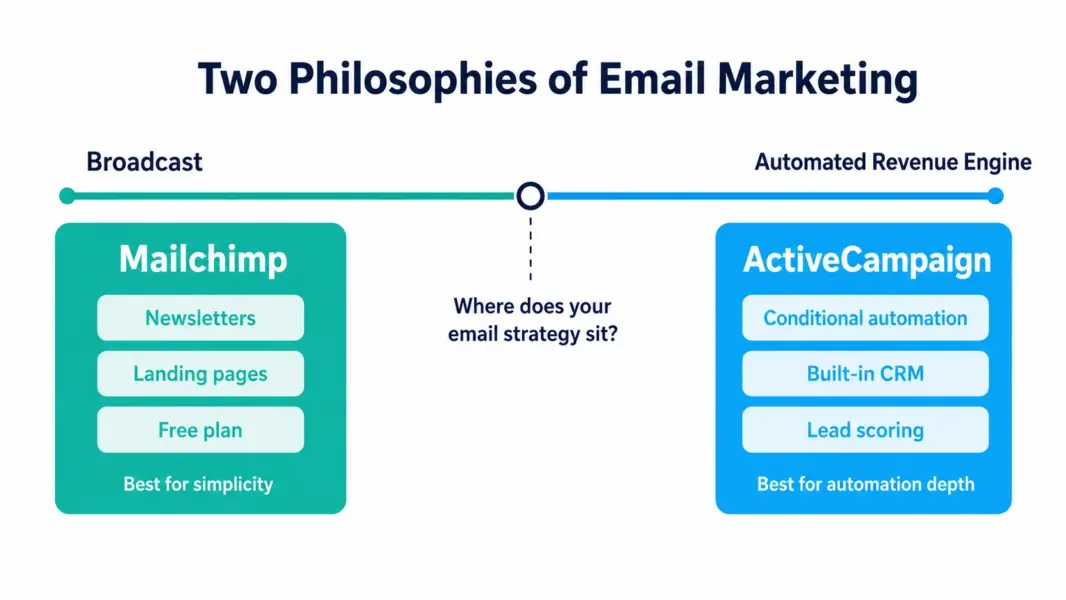
ActiveCampaign treats email as an automated revenue system. Its strength is building behavioral sequences: a contact clicks a pricing page, the system scores them, triggers a tailored follow-up, and alerts sales through the built-in CRM. This is email as automation, not broadcast. For a business that wants email to work while they sleep, ActiveCampaign is built for exactly that.
Pricing: Mailchimp’s First-Year Trap vs ActiveCampaign’s Flat Premium
On the surface Mailchimp looks cheaper, but a critical detail changes the picture. Mailchimp’s advertised pricing often applies to the first year, after which costs rise substantially. ActiveCampaign has no free plan but delivers more automation per dollar at its entry tiers.
| Plan Level | Mailchimp | ActiveCampaign |
|---|---|---|
| Free plan | 500 contacts, 1,000 sends/mo | None (free trial only) |
| Entry paid (1,000 contacts) | ~$26.50/mo (Standard) | $15/mo (Starter) |
| Mid tier with CRM | No native CRM | $49/mo (Plus) |
| 10,000 contacts | ~$100/mo (Standard) | ~$186/mo (Plus) |
| Number of plans | Limited tiers | 7 plans for flexibility |
The pattern: Mailchimp wins on price for simple use and offers a free plan ActiveCampaign lacks. ActiveCampaign costs more but includes a CRM, lead scoring, and automation depth that Mailchimp gates behind higher tiers or does not offer at all. Two pricing traps to watch on Mailchimp: its contact-counting methodology can charge for duplicate contacts across audiences, and promotional first-year pricing rises afterward. Verify current rates on the official pricing pages, since both change frequently.
Automation: ActiveCampaign’s Decisive Advantage
Automation is where ActiveCampaign pulls clearly ahead. Its visual automation builder handles complex customer journeys with conditional if/then branching, goal tracking, and sophisticated logic that Mailchimp cannot match. You can build a sequence that branches based on whether a contact opened an email, visited a page, or hit a deal stage, all in one flow.
Mailchimp’s automation covers the common cases: welcome series, abandoned cart, and birthday emails. It is adequate for simple needs but hits a ceiling fast. According to user reviews compiled across 2026, the most common reason businesses switch from Mailchimp to ActiveCampaign is outgrowing Mailchimp’s automation. ActiveCampaign also added WhatsApp as a native automation channel and an AI Campaign Builder that generates complete workflows from plain-language descriptions.
One more automation factor: deliverability. ActiveCampaign reports inbox placement rates above 94 percent with built-in SPF, DKIM, and DMARC authentication support, which independent comparisons cite as stronger than Mailchimp’s. Higher deliverability means more of your automated sequences actually reach inboxes rather than spam folders.
Ease of Use: Mailchimp’s Home Turf
Mailchimp wins on ease of use, which has been its signature since it made email marketing accessible to non-enterprise users. The interface is clean, the drag-and-drop editor is intuitive, and a beginner can send a polished campaign within an hour of signing up. For solopreneurs and small teams without marketing specialists, this matters enormously.
ActiveCampaign is more powerful and correspondingly more complex. The automation builder, CRM, and segmentation depth require a steeper learning investment. Teams that need its power accept the curve. Teams that only need simple campaigns find ActiveCampaign overwhelming, which is the most common complaint from businesses that chose it for features they did not actually need.
The Built-In CRM: ActiveCampaign’s Unique Edge
ActiveCampaign includes a full CRM with deal pipelines and lead scoring, which Mailchimp does not offer natively. For businesses that connect marketing to sales, this is a decisive feature. Sales reps see every email interaction alongside deal data, marketing automation can trigger based on deal stage, and lead scoring routes hot prospects to sales automatically.
This integration eliminates the need for a separate CRM tool for many small and mid-size businesses, which can offset ActiveCampaign’s higher price. A business paying for Mailchimp plus a separate CRM may find ActiveCampaign’s all-in-one approach cheaper overall. Mailchimp’s strength lies elsewhere: its broader marketing suite of landing pages, social posting, and website tools serves businesses that want marketing breadth over sales-marketing integration.
Which Should You Choose?
Match the platform to how you actually use email. The wrong choice means either paying for automation you will not use or outgrowing a tool that cannot scale with your ambitions.
| Choose ActiveCampaign If | Choose Mailchimp If |
|---|---|
| You need advanced automation with branching | You send simple newsletters and broadcasts |
| You want a built-in CRM with deal pipelines | You want a free plan to start |
| You run behavior-triggered sequences | You are a beginner who values simplicity |
| Deliverability is a priority | You want landing pages and social tools too |
| You connect marketing to sales | Budget is tight for a small contact list |
| You will use the automation depth | Automation needs are basic |
For businesses just starting that want a free plan, see our best free email marketing tools guide. For ecommerce specifically, neither tool matches a dedicated ecommerce platform, as covered in our Klaviyo review.
ActiveCampaign vs Mailchimp: Final Verdict
Mailchimp is the right choice for beginners, small businesses sending newsletters, and anyone who values simplicity and a free plan over automation depth. Its broad marketing suite and ease of use make it the natural starting point for businesses new to email marketing. The caveats are limited automation and pricing that rises after the first year.
ActiveCampaign is the right choice for growing businesses that want email to function as an automated revenue engine, with deep behavioral automation, a built-in CRM, and strong deliverability. It costs more and demands a steeper learning curve, but for businesses that use its power, the automation and sales integration justify the premium. Choose Mailchimp to send email simply; choose ActiveCampaign to automate revenue.
Last updated: May 31, 2026
Frequently Asked Questions
Is ActiveCampaign better than Mailchimp in 2026?
ActiveCampaign is better for businesses needing advanced automation, behavior-triggered sequences, and a built-in CRM. Mailchimp is better for beginners who want simplicity, a broad marketing suite, and a free plan. Neither is universally better. ActiveCampaign wins on automation depth and sales integration; Mailchimp wins on ease of use, marketing breadth, and lower entry cost for simple campaigns.
Is Mailchimp cheaper than ActiveCampaign?
Mailchimp is cheaper for simple use and offers a free plan for up to 500 contacts, which ActiveCampaign lacks. However, Mailchimp’s advertised pricing often applies only to the first year and rises afterward, and its contact-counting can charge for duplicates across audiences. ActiveCampaign starts at $15 per month with more automation included, so the value comparison depends on which features you use.
Does ActiveCampaign have a free plan?
No. ActiveCampaign offers a free trial but no permanent free plan. Its entry Starter plan begins at $15 per month for up to 1,000 contacts. If you need a free plan, Mailchimp offers one for up to 500 contacts, or see dedicated free tools like Brevo, MailerLite, and Sender that offer more generous free tiers than Mailchimp.
Which has better automation, ActiveCampaign or Mailchimp?
ActiveCampaign has significantly better automation. Its visual builder handles complex customer journeys with conditional branching, goal tracking, and lead scoring that Mailchimp cannot match. Mailchimp’s automation covers common cases like welcome series and abandoned cart but hits a ceiling quickly. Outgrowing Mailchimp’s automation is the most common reason businesses switch to ActiveCampaign.
Does Mailchimp have a CRM?
Mailchimp does not have a full native CRM with deal pipelines and lead scoring. It offers basic audience management and contact tagging. ActiveCampaign includes a complete CRM where sales reps see email interactions alongside deal data, and automation can trigger based on deal stage. For businesses connecting marketing to sales, ActiveCampaign’s built-in CRM is a decisive advantage.
Is Mailchimp good for beginners?
Yes. Mailchimp is one of the easiest email marketing tools for beginners, with a clean interface, intuitive drag-and-drop editor, and a free plan to start. A beginner can send a polished campaign within an hour. Its broad marketing suite of landing pages, social tools, and website builder also makes it a good all-in-one starting point for small businesses new to marketing.
Should I switch from Mailchimp to ActiveCampaign?
Consider switching if you have outgrown Mailchimp’s automation, need a built-in CRM, or want behavior-triggered sequences that drive revenue. Stay on Mailchimp if your needs are simple newsletters, you value the free plan, or you use Mailchimp’s broader marketing suite. The switch makes sense when automation depth and sales integration deliver more value than the higher cost and learning curve.
Which is better for ecommerce, ActiveCampaign or Mailchimp?
Both can handle ecommerce, but neither matches a dedicated ecommerce email platform like Klaviyo or Omnisend for deep store integration and predictive analytics. Between the two, ActiveCampaign offers stronger automation for ecommerce sequences, while Mailchimp integrates with Shopify and WooCommerce more simply. For serious ecommerce email revenue, a purpose-built ecommerce tool usually outperforms both.
Related Comparisons and Reviews
- Klaviyo Review 2026
- Best Free Email Marketing Tools 2026
- MailerLite vs Mailchimp 2026
- Brevo Review 2026
- Complete Guide to Email Marketing Software