Shopify vs WooCommerce isn’t a feature comparison. It’s a philosophical question. Do you want a managed platform where someone else handles hosting, security, and updates while you focus on selling? That’s Shopify. Do you want to own your data, code, and server completely, even if that means managing the infrastructure yourself? That’s WooCommerce. Both power millions of stores. Neither is wrong. They serve different types of founders.
What Does Each Actually Cost?
Shopify: Basic $39 per month ($29 annual). Grow $105 ($79 annual). Advanced $399 ($299 annual). Processing: 2.9% + $0.30 with Shopify Payments. Additional 0.5-2% fee for third-party gateways. Realistic total cost with apps: $80 to $150 per month. See our Shopify review.
WooCommerce: Plugin $0 (free, open-source). Hosting $5 to $50 per month. Domain $12 to $20 per year. Premium theme $60 to $200 one-time. Essential extensions $500 to $2,500 per year. Processing: 2.9% + $0.30 (Stripe/WooPayments). Zero platform fees. Realistic year-one cost: $1,800 to $3,000. See our WooCommerce review.
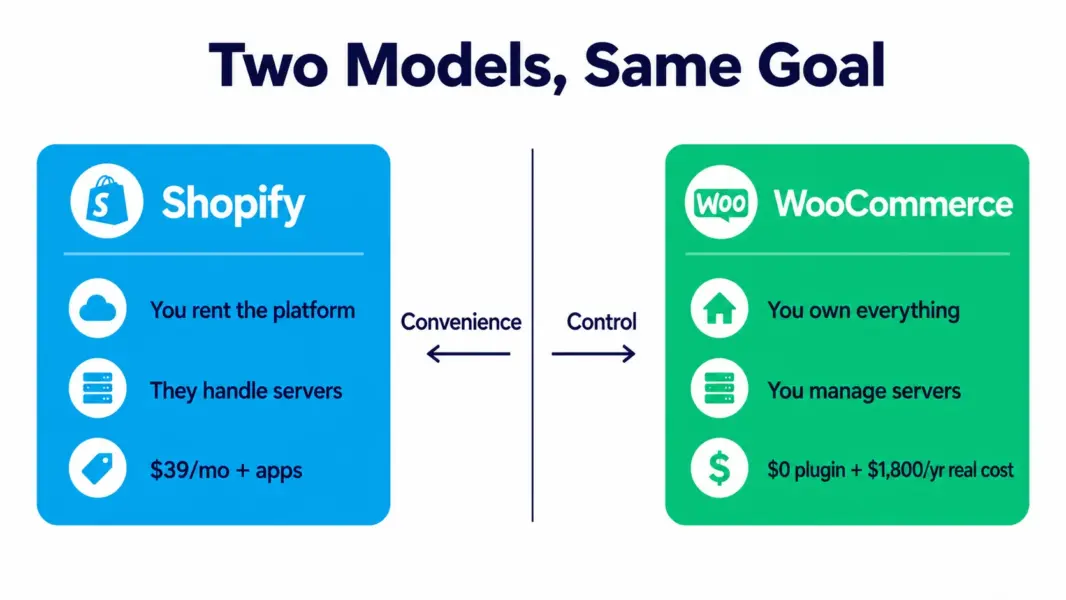
At small scale (under $500K annual revenue), Shopify Basic at $39 per month ($468 per year) is often cheaper all-in than WooCommerce’s $1,800-plus when you factor in hosting, extensions, and the developer time WooCommerce requires. At higher volumes ($1M-plus), WooCommerce’s zero platform fee saves money that Shopify’s per-transaction charges consume.
Pick Shopify If
You’re not technical and want to sell this week without touching server settings. Shopify gets a store live in a day. WooCommerce takes a week of setup including hosting, theme, plugins, and configuration.
You sell across multiple channels. Shopify connects inventory to Amazon, TikTok Shop, Instagram Shopping, Google Shopping, and Walmart from one dashboard. WooCommerce can connect to marketplaces through paid extensions but the integration is less seamless.
You value managed infrastructure. Shopify handles hosting, SSL, security patches, backups, and performance optimization. You don’t think about servers. On WooCommerce, you manage all of it yourself or pay a managed WordPress host $25 to $100 per month to do it for you.
Pick WooCommerce If
You already run a WordPress site. Adding WooCommerce to an existing WordPress site takes an afternoon. Rebuilding that content on Shopify takes weeks. If WordPress powers your blog, your SEO, and your brand, WooCommerce keeps everything on one platform.
Content drives your sales. WooCommerce on WordPress is a content platform with commerce attached. Shopify is a commerce platform with a blog attached. For stores where blog content, SEO, and organic traffic generate the majority of revenue, WordPress’s content foundation provides a competitive advantage Shopify can’t match.
You want data ownership. On Shopify, your data lives on Shopify’s servers under their terms. On WooCommerce, you own the server, the database, every customer record, and the code. If you leave, you take everything. No migration fee, no data hostage.
The Speed and Scale Question
Shopify loads faster out of the box. Independent benchmarks show Shopify pages loading in under 1 second versus 2 to 3 seconds for average WooCommerce installations. WooCommerce CAN match Shopify’s speed with proper hosting, caching, and CDN configuration, but that requires technical effort and higher hosting costs.
Both handle large stores. Shopify powers 4.8 million businesses including brands doing $100M-plus. WooCommerce powers 4.6 million stores including high-volume operations on managed hosting. Scale is not a differentiator. How much you want to manage at scale is.
The Decision Framework
Non-technical, want to sell fast, multi-channel → Shopify. WordPress user, content-driven, want full control → WooCommerce. Design-first, small catalog → Squarespace. Zero budget, testing products → Free ecommerce options. Compare all platforms in our best ecommerce for small business guide.
Last updated: July 25, 2026
Frequently Asked Questions
Is Shopify or WooCommerce cheaper?
At small scale, Shopify Basic at $39 per month ($468 per year) is often cheaper all-in than WooCommerce’s $1,800-plus in hosting and extensions. At higher volumes ($1M-plus revenue), WooCommerce’s zero platform fee makes it cheaper as Shopify’s transaction charges compound. The crossover depends on your extension stack and whether you manage WooCommerce yourself.
Is WooCommerce really free?
The plugin is free. Running a store costs $1,800 to $3,000 per year minimum for hosting ($60-600 per year), extensions ($500-2,500), a domain ($12-20), and payment processing (2.9% + $0.30). WooCommerce is free to install, not free to operate.
Which is easier to use?
Shopify is significantly easier. A non-technical person can build a store in a day. WooCommerce requires WordPress knowledge, plugin management, and hosting configuration. If you’ve never built a website, start with Shopify.
Which is better for SEO?
WooCommerce on WordPress. WordPress’s native blogging, SEO plugin ecosystem (Yoast, RankMath), and content management depth give WooCommerce a structural SEO advantage. Shopify has improved its SEO but remains a commerce platform with a blog attached.
Can I switch from Shopify to WooCommerce later?
Yes, but migration takes 1 to 4 weeks depending on store size. Products, customers, and orders can be exported from Shopify and imported to WooCommerce. Theme design must be rebuilt. Apps don’t transfer. Plan the migration during a slow sales period.
Which has more apps and integrations?
Shopify has 8,000-plus apps in its marketplace. WooCommerce has 800-plus official extensions plus 60,000-plus WordPress plugins. Shopify wins on dedicated ecommerce apps. WooCommerce wins on total WordPress ecosystem breadth.
Related Ecommerce Guides
- Shopify Review 2026
- WooCommerce Review 2026
- Shopify vs Squarespace 2026
- Best Ecommerce for Small Business
- Ecommerce Profit Margin Calculator