The Shopify vs Squarespace decision comes down to one sentence: Shopify is an ecommerce platform that includes website building. Squarespace is a website builder that includes ecommerce. That distinction sounds small but determines everything: pricing structure, app ecosystem, multi-channel selling, design flexibility, and what the platform optimizes for every day. Choose based on what you do primarily, not which feature list looks longer.
The Core Split: What Each Platform Is Built to Do
Shopify launched in 2006 after its founder wanted to sell snowboards online and could not find a platform adequate for the task. Every product decision since has optimized for the selling experience. As of 2026, Shopify powers over 4.6 million live stores across 175 countries and handles roughly 29% of US ecommerce. The platform loads in 0.9 seconds according to CyberNews benchmark testing, which matters because each additional second of load time reduces conversions by up to 7%.
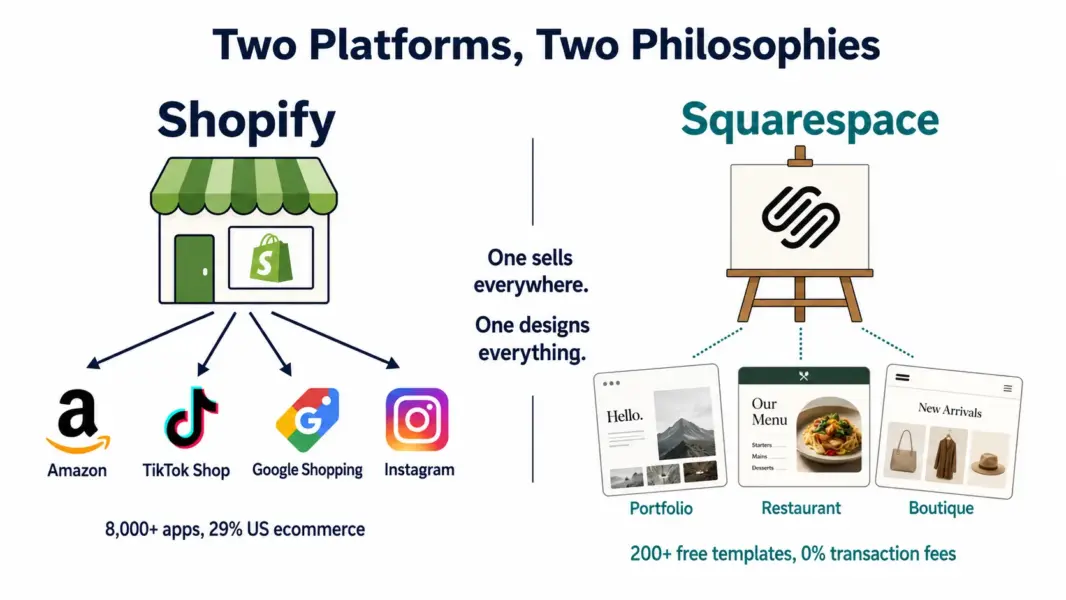
Squarespace launched in 2004 as a website builder for portfolios, blogs, and creative professionals. Its commerce features, added through Commerce plans, are genuinely capable but layered on a platform originally built for visual storytelling. Squarespace powers approximately 4.7 million websites total and captures 39% of the top 10,000 sites built with website builders, according to W3Techs data. Its strength is visual design, not transaction volume.
Pricing: Squarespace Looks Cheaper Until You Factor Real Costs
On sticker price, Squarespace is more affordable. But the real cost comparison is more nuanced once you factor in apps, transaction fees, and theme costs.
| Aspect | Shopify | Squarespace |
|---|---|---|
| Entry ecommerce plan | Basic: $39/mo | Business: $23/mo (3% transaction fee) |
| Zero transaction fees | Only with Shopify Payments | Commerce Basic ($27/mo) and above |
| Mid ecommerce tier | Shopify: $105/mo | Commerce Advanced: $49/mo |
| Credit card processing | 2.9% + $0.30 (Basic) | 2.9% + $0.30 (Commerce Basic) |
| Free templates | 24 (paid: $100-500) | 200+ (all free) |
| Average app spend | $120-200/mo extra | Minimal (features included) |
| Realistic small store monthly cost | $80-150/mo (with apps) | $27-49/mo (all-in) |
The realistic small store comparison is the number that matters. Shopify’s $39 base balloons to $80 to $150 per month once you add 3-5 essential apps for reviews, upsells, and email marketing. Squarespace includes most of these features natively. However, at higher order volumes, Shopify’s lower processing fees and operational efficiency offset the higher subscription cost. The breakeven typically occurs around 200-300 orders per month.
Ecommerce Features: Shopify Wins and It Is Not Close
Shopify’s ecommerce depth is in a different category from Squarespace. The 8,000-plus app ecosystem, multi-channel selling across Amazon, TikTok, Instagram, Google Shopping, and Walmart, point-of-sale hardware for physical retail, and advanced shipping rules create a commerce infrastructure that Squarespace does not attempt to match.
Squarespace covers the fundamentals: unlimited products on Commerce plans, checkout on your own domain, gift cards, discount codes, and abandoned cart recovery on Commerce Basic. For a small store selling 10-50 products with straightforward shipping, this is sufficient. The moment you need subscription selling, advanced inventory management, international multi-currency storefronts, or wholesale channels, Shopify’s capabilities become necessary.
Design and Templates: Squarespace’s Territory
Squarespace’s 200-plus free templates are the most visually polished in the website builder category, with clean lines, modern typography, and responsive layouts that require minimal customization. Creative professionals, photographers, restaurants, and studios consistently choose Squarespace for visual quality that Shopify’s commerce-optimized themes do not match out of the box.
Shopify offers 24 free themes and over 1,000 paid themes ($100-500 each). The themes are designed for conversion rather than editorial design, which is the right tradeoff for a commerce-first platform but feels rigid for businesses where brand presentation matters more than checkout optimization.
Multi-Channel Selling: Shopify’s Decisive Advantage
Shopify natively connects to more than 10 social media channels plus Amazon and Google Shopping. Shopify Markets handles multi-currency, multi-language storefronts with duty and tax management for international selling. For businesses that sell across multiple platforms, Shopify provides unified inventory and order management from one dashboard.
Squarespace supports multichannel selling through integrations with Facebook and Instagram, but Amazon and other marketplace connections require third-party apps. International selling capabilities are limited on lower plans, with multi-currency support restricted to higher tiers. For businesses selling only through their own website, this limitation may not matter. For businesses expanding to marketplaces and social commerce, Shopify is the clear winner.
Who Should Choose Which?
| Choose Shopify If | Choose Squarespace If |
|---|---|
| Selling products is your primary business activity | Your website’s primary purpose is content, with selling secondary |
| You plan to sell on Amazon, TikTok, Instagram, or marketplaces | You sell only through your own website |
| You have or plan a catalog of 50-plus products | You sell 10-50 products alongside services or content |
| You need POS for physical retail | You are a photographer, designer, restaurant, or creative |
| You want the deepest app ecosystem for customization | You want beautiful design without paying for premium themes |
| International selling with multi-currency matters | Budget is tight and you want the lowest all-in monthly cost |
For dedicated ecommerce comparisons beyond these two, see our upcoming guides covering WooCommerce and other platforms in the complete guide to ecommerce platforms.
Final Verdict
Shopify wins for businesses where selling products is the primary activity. Its ecommerce depth, multi-channel reach, and app ecosystem serve product-focused businesses at every scale from startup to enterprise. The total cost is higher than Squarespace, but the commerce capability justifies it for serious stores. Squarespace wins for businesses where a beautiful website is the primary activity and selling products is a secondary function. Creatives, restaurants, service providers, and small shops with simple catalogs get better design, lower all-in costs, and less complexity. Choose by what you do most: sell products, pick Shopify; build a brand site that also sells, pick Squarespace.
Last updated: July 7, 2026
Frequently Asked Questions
Is Shopify or Squarespace better for ecommerce in 2026?
Shopify is better for dedicated ecommerce. It offers 8,000-plus apps, multi-channel selling across Amazon, TikTok, and Google Shopping, POS hardware, and infrastructure serving 29% of US ecommerce. Squarespace is better for design-first websites that also sell products as a secondary function. Choose Shopify when selling is primary; choose Squarespace when the website is primary.
Is Squarespace cheaper than Shopify?
On sticker price, yes. Squarespace Commerce Basic at $27 per month is cheaper than Shopify Basic at $39 per month. On real cost, the gap narrows because Shopify’s average store spends $120 to $200 per month on apps that Squarespace includes natively. Squarespace’s realistic all-in cost is $27 to $49 per month versus Shopify’s $80 to $150, making Squarespace cheaper for small stores with simple needs.
Does Squarespace charge transaction fees?
Squarespace’s Business plan charges a 3% transaction fee on top of credit card processing. Commerce Basic and Commerce Advanced plans eliminate the platform transaction fee entirely, charging only the credit card processing rate. Shopify charges an additional 0.5 to 2% transaction fee only if you do not use Shopify Payments.
Can Squarespace handle a large online store?
Squarespace handles small to mid-size stores well (up to about 50 products with simple variations). For stores with 100-plus products, complex inventory, multiple sales channels, or international multi-currency needs, Shopify provides significantly more capability. According to industry analysis, merchants who start on Squarespace frequently migrate to Shopify once their catalog grows past 30-40 products.
Which has better website templates?
Squarespace has better templates overall, with 200-plus free, professionally designed layouts for portfolios, blogs, restaurants, and creative businesses. Shopify offers 24 free themes (with 1,000-plus paid themes at $100-500 each) optimized for conversion rather than editorial design. If visual design quality is your priority, Squarespace wins. If sales conversion matters more, Shopify’s themes deliver.
Can I sell on Amazon with Squarespace?
Not natively. Squarespace does not offer direct Amazon integration. You can connect through third-party apps like LitCommerce, but the experience is less seamless than Shopify’s native Amazon channel. Shopify supports native selling on Amazon, TikTok, Instagram, Facebook, Google Shopping, Pinterest, and Walmart from a unified dashboard.
Is Shopify faster than Squarespace?
Yes. Independent benchmark testing shows Shopify loading in 0.9 seconds versus Squarespace at 2.25 seconds. This speed difference matters for ecommerce conversion rates, since each additional second of load time can reduce conversions by up to 7%. Shopify’s infrastructure is optimized for high-traffic commerce operations.
Related Ecommerce Comparisons and Guides
- WooCommerce Review 2026
- Squarespace Review 2026
- Best Ecommerce for Small Business
- Best Free Ecommerce Platforms
- Complete Guide to Ecommerce Platforms