Pros
- Plugin is permanently free with no monthly platform fee
- Zero transaction fees from WooCommerce (only payment processor fees)
- Full data ownership and code control (no platform lock-in)
- Best SEO capability in ecommerce (native WordPress integration)
- 800-plus extensions for every ecommerce model (subscriptions, bookings, memberships)
- Powers 4.6 million-plus active stores and 26% of all online stores globally
- Supports physical, digital, variable, grouped, affiliate, and subscription products
- Works with any WordPress theme and 60,000-plus WordPress plugins
Cons
- "Free" plugin costs $1,800 to $3,000-plus per year minimum in hosting, extensions, and fees
- You manage hosting, security, updates, backups, and performance (Shopify handles all of this)
- Plugin stack of 15-25 extensions creates compatibility risk and maintenance burden
- Essential extensions (subscriptions $199/yr, bookings $249/yr, automation $99/yr) add up fast
- No dedicated support team (community forums and hosting provider support only)
- Performance degrades with poor hosting and plugin bloat
- Steeper learning curve than Shopify or Squarespace for non-technical users
- Plugin dependency means features others include natively require paid add-ons
This WooCommerce review starts with the number most reviews delay until paragraph twelve: a production-ready WooCommerce store costs $1,800 to $3,000 per year at minimum, despite the plugin being free. That number includes hosting, a domain, essential extensions, a premium theme, and payment processing. It does not include developer time, which is where costs can escalate to $10,000 to $50,000-plus for custom builds. WooCommerce is genuinely free to install. It is not free to run. Understanding that distinction is the entire review.
Starting Price: $0 (plugin free) | Hosting: $5-50+/mo extra | Free Plan: Yes (open-source, permanent) | Free Trial: N/A
What “Free” Actually Costs
WooCommerce’s pricing model is unlike any other ecommerce platform. There is no monthly subscription. No platform transaction fee. No seat limit. You download the plugin, install it on WordPress, and start building. The costs appear in the infrastructure and tools required to run a live, secure, functional store.
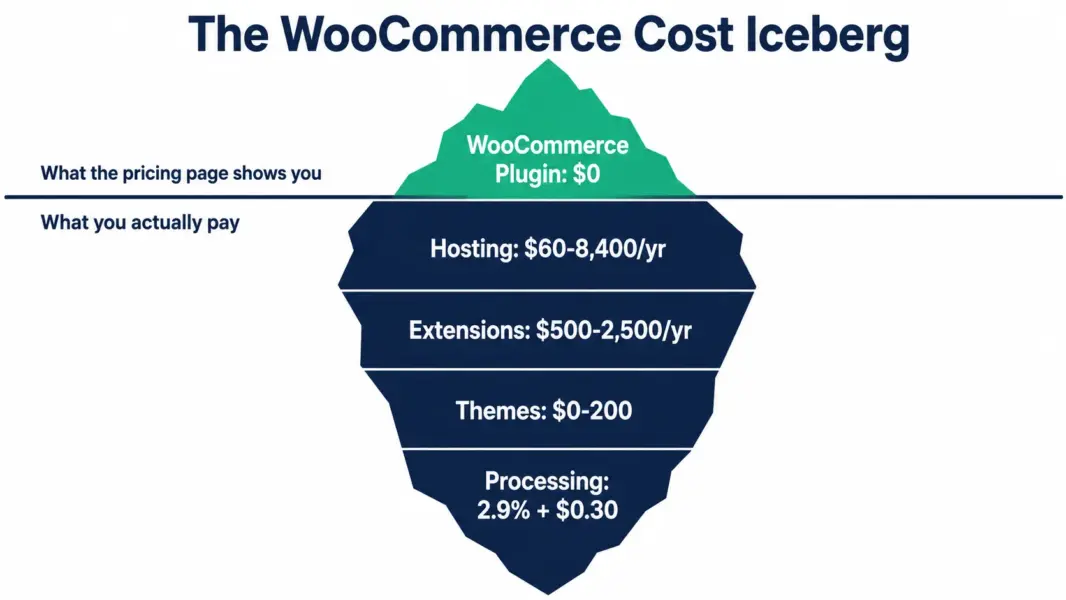
Hosting ($60 to $8,400 per year). Shared hosting from providers like Bluehost or SiteGround costs $5 to $30 per month and works for stores under $100K in annual revenue. Managed WordPress hosting from Kinsta ($70-700 per month), WP Engine ($50-500 per month), or Cloudways ($25-300 per month) delivers the performance, security, and automatic backups that serious stores need. According to IWD Agency’s 2026 breakdown, cheap shared hosting works initially but “breaks at scale,” and most growing stores migrate to managed hosting within 12 to 18 months.
Extensions ($500 to $2,500 per year). WooCommerce’s modular architecture means every advanced feature requires a separate plugin with its own annual renewal fee. WooCommerce Subscriptions costs $199 per year. WooCommerce Bookings costs $249. AutomateWoo for marketing automation costs $99. Advanced inventory management runs $99 to $299. According to G2 reviews, the most common frustration is that plugins which were previously free add paid tiers, and plugins that stop being maintained force switches to paid alternatives. A store running 15 to 25 plugins, which is common for production WooCommerce stores, carries ongoing compatibility and renewal overhead.
Themes ($0 to $200). The official Storefront theme is free and guaranteed compatible. It is also generic. Premium themes like Astra Pro, Flatsome, or Woodmart cost $60 to $200 and deliver the design quality and customization that make stores look professional. Custom theme builds run $500 to $5,000.
Payment processing (2.9% plus $0.30 per transaction). WooPayments (powered by Stripe) and direct Stripe integration both charge standard rates. WooCommerce itself adds zero transaction fees on top, which is a genuine advantage over Shopify’s 0.5 to 2% additional fee for third-party gateways.
The Ownership Advantage Nobody Else Offers
WooCommerce is the only major ecommerce platform where you own your data, your code, and your hosting completely. On Shopify, you rent space on their servers under their terms. On Squarespace, your data lives in their cloud. On WooCommerce, you control the server, the database, the checkout flow, the code, and every customer record. If you decide to leave, you export everything and move. No migration fee, no data hostage, no platform dependency.
This ownership matters for three types of businesses. Content-driven stores where WordPress’s native blogging and SEO capability drives traffic. Stores with unique checkout or fulfillment requirements that hosted platforms cannot accommodate. Businesses in regulated industries that need to control where customer data is stored and how it is processed. According to W3Techs data, WooCommerce powers approximately 26% of all online stores globally, with over 4.6 million active installations, confirming that the ownership model serves a massive market despite the technical overhead.
The SEO Advantage That Matters Most
WooCommerce running on WordPress is the strongest SEO foundation in ecommerce. Product pages, category pages, blog content, metadata, URLs, schema markup, internal links, and long-tail content are all controlled through WordPress’s mature SEO ecosystem. Plugins like Yoast SEO and RankMath add structured data, XML sitemaps, and content analysis directly to product and category editors.
For stores where organic search drives the majority of traffic, WooCommerce’s content-first architecture is a competitive advantage that Shopify’s more rigid content management system does not match. Shopify has improved its SEO capabilities but remains a commerce platform with a blog attached, while WooCommerce is a content platform with commerce attached. If content marketing is your growth strategy, WooCommerce’s native WordPress integration is the strongest foundation available.
When WooCommerce Is Cheaper Than Shopify (and When It Is Not)
The WooCommerce-versus-Shopify cost comparison is not straightforward because WooCommerce’s modular costs vary by store complexity while Shopify’s are fixed.
A small store selling 20 products with basic shipping on WooCommerce: managed hosting ($25 per month), premium theme ($100 one-time), 3 extensions ($300 per year), domain ($15 per year). Annual cost: approximately $630 plus payment processing. The same store on Shopify Basic: $39 per month ($468 per year) plus a paid theme ($150 one-time). Annual cost: approximately $618 plus payment processing plus Shopify’s additional transaction fee if not using Shopify Payments. At small scale, the costs are comparable, but Shopify includes hosting, security, updates, and support that WooCommerce requires you to manage yourself.
A mid-size store doing $500K in annual revenue with subscriptions, advanced shipping, and marketing automation on WooCommerce: managed hosting ($70 per month), 8 extensions ($1,200 per year), custom theme ($2,000 one-time amortized). Annual cost: approximately $2,840 plus processing. On Shopify ($105 per month plan): $1,260 per year plus app costs of approximately $100 to $200 per month. Annual cost: approximately $2,460 to $3,660. At mid-scale, WooCommerce can be cheaper if you minimize extensions, but Shopify’s managed infrastructure eliminates the developer overhead WooCommerce requires.
WooCommerce becomes clearly cheaper at higher volumes ($1M-plus revenue) where Shopify’s transaction fees on the Basic and standard plans compound, and where WooCommerce’s zero platform fee advantage delivers cumulative savings.
Who Should Build on WooCommerce
Businesses already running WordPress websites that want to add ecommerce without rebuilding on a new platform. Content-driven brands where blog content, SEO, and organic traffic are the primary growth channels. Stores with custom workflows (unique checkout, complex shipping rules, industry-specific integrations) that hosted platforms cannot accommodate without expensive custom development. Teams with WordPress development capacity, either in-house or through an affordable developer relationship. Businesses that prioritize data ownership and are willing to manage infrastructure to maintain it.
Who Should Choose Shopify Instead
Non-technical founders who want to launch a store this week without touching server settings. Businesses where selling across Amazon, TikTok, Instagram, and marketplaces matters more than SEO depth. Teams without developer access who need hosting, security, and updates handled by the platform. Stores where predictable monthly costs matter more than long-term cost optimization. For the full head-to-head, see our Shopify vs Squarespace comparison and our best ecommerce for small business guide.
Last updated: July 11, 2026
Frequently Asked Questions
Is WooCommerce really free in 2026?
The WooCommerce plugin is permanently free and open-source. Running a real store is not. Hosting costs $5 to $50-plus per month, essential extensions cost $500 to $2,500 per year, premium themes cost $60 to $200, and payment processing runs 2.9% plus $0.30 per transaction. A realistic small store spends $1,800 to $3,000 per year. WooCommerce is free to install but not free to operate.
How much does a WooCommerce store actually cost per year?
A small store costs $1,800 to $3,000 per year (shared hosting, basic extensions, premium theme, processing fees). A mid-size store costs $3,000 to $10,000 (managed hosting, 8-12 extensions, custom theme amortization). Enterprise custom builds can exceed $50,000 in year one including development costs. The range depends on hosting quality, extension stack, and whether you manage the site yourself or hire developers.
Is WooCommerce cheaper than Shopify?
At small scale (under $500K annual revenue), costs are comparable and Shopify often wins when you factor in the hosting, security, and maintenance that Shopify includes and WooCommerce requires you to manage. At higher volumes ($1M-plus revenue), WooCommerce becomes cheaper because it charges zero platform or transaction fees. The crossover point depends on your extension stack and developer costs.
Is WooCommerce good for SEO?
WooCommerce on WordPress is the strongest SEO foundation in ecommerce. You control product pages, categories, blog content, metadata, URLs, schema, and internal links through WordPress’s mature SEO ecosystem. For content-driven stores where organic search is the primary traffic channel, WooCommerce’s native WordPress integration is a genuine competitive advantage over Shopify’s more limited content management.
Can WooCommerce handle a large store?
Yes, with proper architecture. Large stores require managed hosting (Kinsta, WP Engine), object caching (Redis or Memcached), a CDN (Cloudflare or Fastly), database optimization, and careful plugin selection. Stores doing $10M-plus in annual revenue run successfully on WooCommerce. The architecture work to reach that scale is non-trivial and typically requires professional development support.
Does WooCommerce charge transaction fees?
No. WooCommerce itself charges zero transaction fees. You pay only the payment processor’s fees (typically 2.9% plus $0.30 per transaction through WooPayments or Stripe). This is a genuine advantage over Shopify, which adds 0.5% to 2% on top of payment processing if you do not use Shopify Payments.
Should I use WooCommerce or Shopify for my first store?
Use Shopify if you want to launch quickly without technical involvement. Use WooCommerce if you already have a WordPress site, have developer access, and prioritize data ownership and SEO. For first-time store owners without technical skills, Shopify’s managed infrastructure removes the hosting, security, and maintenance burden that WooCommerce requires.
Related Ecommerce Guides
- Shopify vs Squarespace 2026
- Best Ecommerce for Small Business
- Best Free Ecommerce Platforms
- Complete Guide to Ecommerce Platforms
WooCommerce is the most flexible ecommerce platform available and the only one where you own your data, code, and hosting completely. The plugin is free. Running a real store is not. A production-ready WooCommerce store costs $1,800 to $3,000 per year at minimum (hosting plus essential extensions plus payment processing), scaling to $10,000-plus for complex operations. The tradeoff is ownership versus convenience: you get unlimited customization and zero platform fees, but you manage everything Shopify handles for you. WooCommerce is the right choice for WordPress-native businesses, content-driven stores where SEO matters most, and teams with technical capacity to manage infrastructure. It is the wrong choice for non-technical founders who want to launch fast without touching server settings.