Pros
- Best-in-class design templates across 200-plus professionally designed layouts
- No transaction fees on Plus and Advanced plans
- Free custom domain included with annual plans for the first year
- All plans include SSL, unlimited bandwidth, and unlimited storage
- Built-in SEO tools available on every plan including Basic
- 14-day free trial with no credit card required
- Integrated scheduling through Acuity Scheduling acquisition
Cons
- No free plan available at any tier
- Basic plan charges 2% store transaction fee plus 7% on digital products
- Core plan still charges 5% on digital products and memberships
- Limited to roughly 40-50 extensions versus Shopify's 8,000-plus apps
- No native multi-channel selling to Amazon, TikTok Shop, or Google Shopping
- Custom code access (CSS and JavaScript) locked behind Core plan and above
- Advanced plan at $99 per month annual is expensive for what it includes versus Shopify
This Squarespace review covers the platform that won the design war and lost the ecommerce one. Squarespace templates are the most visually polished in the website builder category. No competitor produces sites that look this good out of the box. The 4 million websites running on Squarespace prove the design advantage is real. The limitation is equally real: a 40-extension marketplace versus Shopify’s 8,000 apps, no native selling on Amazon or TikTok, and a Basic plan that charges 2% on every sale. Squarespace is the right platform when your website is your brand. It is the wrong one when selling at scale is the job.
Starting Price: $16/mo Basic (annual) | $25/mo (monthly) | Free Plan: No | Free Trial: 14 days, no credit card
The New Plan Structure: Basic Through Advanced
Squarespace rolled out new plan names in late 2025, replacing the old Personal, Business, and Commerce tiers. The current structure as of 2026 is four plans that progress from personal sites to advanced ecommerce.
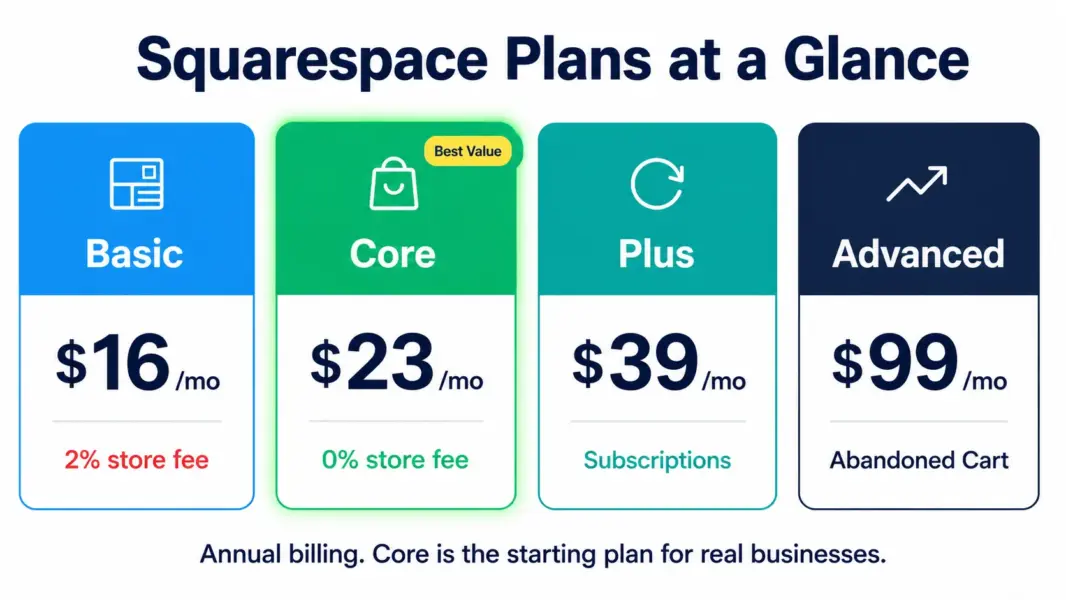
Basic at $16 per month (annual) or $25 (monthly). Suitable for personal sites, blogs, and simple portfolios. Includes unlimited bandwidth, storage, and all SEO features. Ecommerce is technically available but comes with a 2% Squarespace transaction fee on store sales and 7% on digital products, making it impractical for any real selling volume. No CSS or JavaScript customization access.
Core at $23 per month (annual) or $33 (monthly). The sweet spot for most small businesses. Eliminates the store transaction fee (0%), reduces digital product fees to 5%, adds CSS and JavaScript access, unlimited contributors, professional email integration through Google Workspace, and expanded analytics. According to multiple 2026 reviews including Jaks Digital, Core is the realistic starting plan for any business site because Basic’s lack of code access and transaction fees limit what you can actually build and sell.
Plus at $39 per month (annual) or $56 (monthly). Built for businesses actively selling online. Adds subscription product selling, advanced shipping with real-time carrier rates, advanced discounting, and customer accounts. Reduces digital product fees to 1%. The Plus plan is where Squarespace starts competing with dedicated ecommerce platforms rather than just being a website builder with checkout attached.
Advanced at $99 per month (annual) or $139 (monthly). Squarespace’s most expensive tier adds abandoned cart recovery, commerce APIs, the lowest payment processing rates (2.5% plus $0.30), and unlimited video storage. Abandoned cart recovery alone can justify the upgrade for stores doing $2,000 or more in monthly revenue. According to Ecommerce Paradise, if abandoned cart emails recover even 5 to 10% of abandoned orders, the $60 monthly difference from Plus pays for itself quickly.
Where Squarespace Genuinely Wins
Squarespace’s design quality is not marketing fluff. The templates are created by professional designers, not just developers, and the difference shows in typography, spacing, grid alignment, and responsive behavior. A photographer, architect, restaurant, or boutique brand can launch a site on Squarespace in a weekend that looks like it cost $5,000 to design. That design advantage is the core reason 4 million websites choose Squarespace over cheaper alternatives.
The Fluid Engine drag-and-drop editor provides genuine layout control without code. You position elements freely on a grid, adjust spacing visually, and preview responsive behavior in real time. For non-technical users, this produces more polished results than WordPress page builders that require more CSS understanding to look right.
SEO tools are included on every plan, including Basic. Custom meta titles, descriptions, clean URL structures, automatic sitemaps, SSL certificates, and mobile-responsive layouts are standard. For personal brands and service businesses that rely on Google search for discovery, Squarespace’s built-in SEO covers the fundamentals without plugins or additional cost.
Where Squarespace Falls Short for Ecommerce
Squarespace’s ecommerce limitations become clear once you compare its ecosystem to Shopify’s. The extension marketplace offers roughly 40 to 50 integrations versus Shopify’s 8,000-plus apps. Inventory management, advanced product filtering, subscription logic, and loyalty programs that Shopify handles through apps require workarounds or third-party connections on Squarespace.
Multi-channel selling is limited. Squarespace connects to Facebook and Instagram for direct selling but lacks native integrations with Amazon, TikTok Shop, Google Shopping, Pinterest Shop, and Walmart. For brands where marketplace revenue represents a significant portion of sales, Squarespace cannot serve as a centralized selling platform. See our Shopify vs Squarespace comparison for the full ecommerce head-to-head.
Product catalog management becomes friction around 40 to 50 products. The admin interface is designed for small catalogs. Bulk editing, variant management, and collection organization are simpler on Shopify’s commerce-focused dashboard. Stores planning to grow beyond 50 SKUs should evaluate whether Squarespace’s catalog tools scale with their ambitions.
Who Should Build on Squarespace
Creative professionals who need a portfolio that sells their work visually: photographers, designers, architects, artists, writers. Service businesses where the website is the first impression: restaurants, salons, consultants, coaches, law firms. Small stores selling under 30 products where brand presentation matters more than catalog depth. Content creators who blog alongside selling and want strong built-in SEO without plugins.
Who Should Choose Shopify or WordPress Instead
Product-focused businesses planning to sell on Amazon, TikTok, and Google Shopping alongside their own site. Stores expecting catalog growth beyond 50 products. Teams that need extensive app integrations for reviews, loyalty, subscriptions, and advanced fulfillment. Businesses that prioritize page speed for ecommerce conversion, where independent benchmarks show Shopify loading in 0.9 seconds versus Squarespace at 2.25 seconds. For the full platform comparison, see our best ecommerce for small business guide.
Try Squarespace Free for 14 Days
Last updated: July 21, 2026
Frequently Asked Questions
How much does Squarespace cost in 2026?
Squarespace offers four plans billed annually: Basic at $16 per month, Core at $23, Plus at $39, and Advanced at $99. Monthly billing is 28 to 40% higher. All annual plans include a free custom domain for the first year. There is no free plan, but a 14-day free trial requires no credit card.
Does Squarespace charge transaction fees?
Basic charges a 2% Squarespace fee on store sales and 7% on digital products, on top of payment processing. Core eliminates the store fee but charges 5% on digital products. Plus and Advanced charge 0% and 1% on digital products respectively. Payment processing (2.5 to 2.9% plus $0.30 per transaction via Stripe) applies on all plans.
Which Squarespace plan is best for small business?
Core at $23 per month annual is the best value for most small businesses. It eliminates store transaction fees, adds CSS and JavaScript customization, includes unlimited contributors, and provides expanded analytics. Basic lacks code access and charges transaction fees that make it impractical for selling. Most businesses start on Core and upgrade to Plus only when they need subscriptions or advanced shipping.
Is Squarespace good for ecommerce?
Squarespace handles small to mid-size stores (under 30 to 50 products) well, with strong design, built-in checkout, and zero transaction fees on Plus and above. It is not ideal for high-volume ecommerce or multi-channel selling. Squarespace lacks native Amazon, TikTok Shop, and Google Shopping integrations and has roughly 40 extensions versus Shopify’s 8,000 apps.
Is Squarespace better than Shopify?
Squarespace is better for design-first websites where visual quality matters most. Shopify is better for dedicated ecommerce with multi-channel selling, deep app ecosystem, and faster page loads. Choose Squarespace when your website IS your brand. Choose Shopify when selling products is your primary activity.
Does Squarespace include hosting?
Yes. All Squarespace plans include hosting, SSL security, unlimited bandwidth, unlimited storage, and 24/7 customer support. There is no separate hosting cost. This is a genuine advantage over WordPress and WooCommerce, which require separate hosting starting at $5 to $50 per month.
Related Ecommerce Guides
- Shopify vs Squarespace 2026
- WooCommerce Review 2026
- Best Ecommerce for Small Business
- Complete Guide to Ecommerce Platforms
Squarespace produces the most visually polished websites in the builder category. Its 200-plus templates are designed by professional designers and look better out of the box than any competitor. For creatives, portfolios, restaurants, service businesses, and small stores where brand presentation drives purchasing decisions, Squarespace delivers genuine design value that justifies its pricing. The limitation is ecommerce depth: Basic charges 2% on sales, the extension ecosystem is a fraction of Shopify's, and multi-channel selling to Amazon and TikTok is not natively supported. Squarespace is the right platform when your website IS your brand. It is the wrong platform when selling products at scale is your primary business activity.