Pros
- Powers 4.8 million businesses and handles 29% of US ecommerce
- Multi-channel selling to Amazon TikTok Shop Instagram Google Shopping and Walmart from one dashboard
- 8,000 plus apps in the Shopify App Store for every ecommerce function imaginable
- Shopify Payments eliminates third-party gateway fees on all plans
- New Agentic plan lets AI assistants sell your catalog at $0 per month base
- POS hardware for brick-and-mortar stores synced with online inventory
- 3-day free trial plus $1 per month for first 3 months lowers entry barrier
Cons
- Realistic monthly cost is $80 to $150 after essential apps not the $39 headline
- Basic plan charges 2.9% plus $0.30 per transaction with 2% fee for non-Shopify gateways
- Grow plan renamed from Shopify plan and jumped from $79 to $105 per month in 2024
- Annual price hikes of 30 to 35% over the past 3 years concern long-term merchants
- Free themes look generic and premium themes cost $100 to $400 one-time
- Shopify email marketing is basic compared to Klaviyo or Mailchimp
- App dependency means essential features cost extra monthly on top of the subscription
Every ecommerce platform comparison ends with “but Shopify is the standard.” It is. 4.8 million businesses. 29% of US ecommerce. Multi-channel selling across Amazon, TikTok, Instagram, and Google Shopping from one dashboard. Infrastructure that handles Black Friday spikes without a sweat. That reputation is earned.
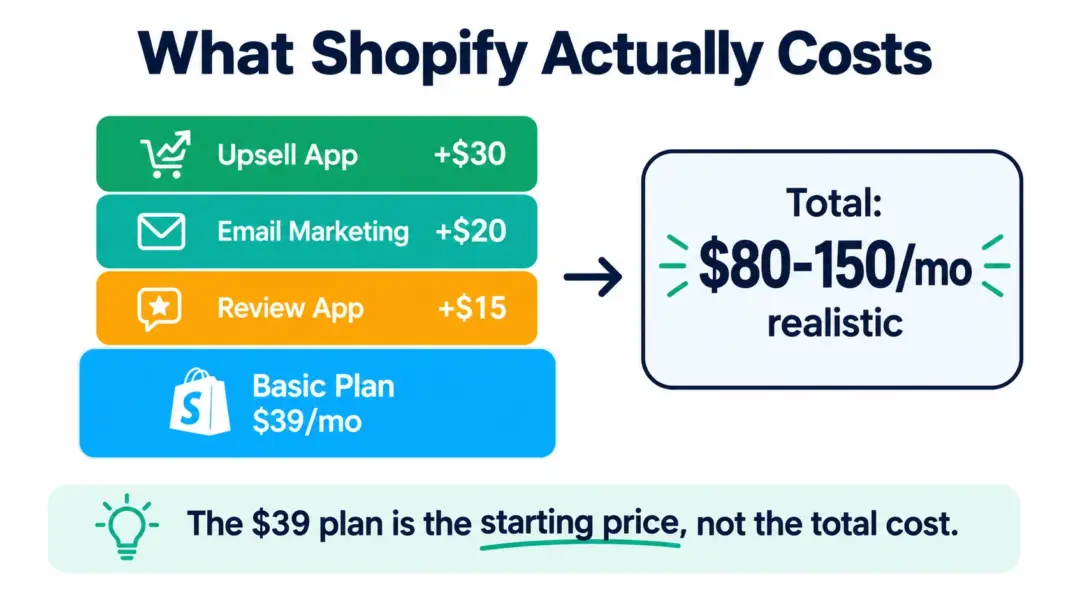
What the reputation doesn’t tell you is the real cost. Shopify Basic says $39 per month. Most stores actually spend $80 to $150 once they add essential apps for product reviews, email marketing, upsells, and subscriptions. That gap between headline and reality is what this review covers honestly.
Starting Price: $39/mo Basic ($29 annual) | Free Plan: No | Free Trial: 3 days free + $1/mo for 3 months
What Does Shopify Cost in 2026?
Starter ($5 per month). No standalone store. Sell through social media, messaging, and Shopify’s link-in-bio. Good for testing whether a product sells before investing in a full store.
Agentic ($0 per month). New in 2026. Your product catalog gets listed for sale through AI assistants like ChatGPT, Gemini, Copilot, and the Shop app. No storefront. You pay only when a sale completes. Worth activating alongside any other plan at zero risk.
Basic ($39 monthly, $29 annual). Full online store with unlimited products. 2 staff accounts. Processing at 2.9% plus $0.30 with Shopify Payments. 2% extra fee if you use a third-party payment gateway. This is where most new stores start.
Grow ($105 monthly, $79 annual). Renamed from “Shopify” plan in 2024, price went from $79 to $105. 5 staff accounts. Processing drops to 2.7% plus $0.30. Professional reports. 1% third-party gateway fee. Upgrade when you need better analytics or the lower processing rate saves more than the $66 monthly difference.
Advanced ($399 monthly, $299 annual). 15 staff accounts. Processing at 2.5% plus $0.30. Third-party calculated shipping. Custom reports. Advanced at $399 makes financial sense once your monthly revenue exceeds roughly $50,000, where the lower processing rate saves more than the subscription difference from Grow.
Plus ($2,300 to $2,500 per month). Enterprise tier. Custom checkout, B2B capabilities, dedicated support. Required for large-volume merchants doing $1M-plus annually.
Annual billing saves 25% on Basic, Grow, and Advanced. The $1 per month for 3 months promotional offer (after the free trial) is the cheapest way to test the full platform before committing to standard rates.
The Real Cost Nobody Puts on the Pricing Page
The $39 Basic plan gives you a functional store. A competitive store costs more. According to industry analysis, most merchants pay 2 to 3 times their base plan once you factor in apps, themes, and processing.
A typical small store stack: product reviews app ($10 to $20 per month), email marketing ($15 to $30), upsells or cross-sells ($20 to $40), subscription management if applicable ($40 to $100). That adds $45 to $190 in app costs on top of the $39 base. Add a premium theme ($100 to $400 one-time) and your realistic first-year cost is $1,500 to $3,000, not the $468 the Basic plan suggests.
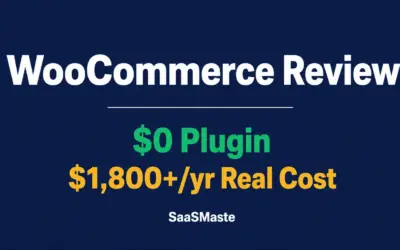
Compare that to Squarespace Commerce at $23 to $39 per month, where most features are built in without app costs. Or WooCommerce where the plugin is free but hosting and extensions run $1,800-plus per year. The realistic costs are closer than the headline prices suggest. See our Shopify vs Squarespace comparison for the full breakdown.
Where Shopify Genuinely Wins
Multi-channel selling. No other platform connects your inventory to Amazon, TikTok Shop, Instagram Shopping, Facebook, Google Shopping, Pinterest, and Walmart from a single dashboard this seamlessly. If you sell on marketplaces alongside your own store, Shopify’s channel integration eliminates the multi-system chaos.
The app ecosystem. 8,000-plus apps covering every ecommerce function. Subscription selling, loyalty programs, print-on-demand, dropshipping, affiliate marketing, advanced analytics. Whatever your store needs, there’s an app. The depth is unmatched.
Infrastructure reliability. Shopify hosts your store on its servers. SSL, security, uptime, and scalability are handled. Your store doesn’t crash during a product launch or sale event. That managed infrastructure is worth real money compared to the DevOps overhead of self-hosted solutions like WooCommerce.
Where Shopify Shows Its Limits
Content management. Shopify is a store with a blog attached, not a content platform with a store attached. Blog formatting, SEO control, and content flexibility trail WordPress and Squarespace. For content-driven brands where blogging drives organic traffic, this limitation matters.
Price trajectory. Basic went from $29 to $39 (34% increase). Grow went from $79 to $105 (33%). The consistent 30 to 35% annual increases concern merchants signing up today who’ll face higher rates at renewal. Budget for increases.
Who Should Build on Shopify
Product-focused businesses where selling is the primary activity. Multi-channel sellers on Amazon, TikTok, and social platforms. Brick-and-mortar stores adding online sales with POS integration. Businesses that value managed infrastructure over self-hosted control. For more ecommerce options, see our best ecommerce for small business and best free ecommerce guides.
Who Should Choose Squarespace or WooCommerce
Design-first brands where visual quality matters more than selling depth → Squarespace. Content-driven businesses where SEO and blogging drive traffic → WooCommerce on WordPress. Budget-constrained businesses wanting lower all-in monthly cost → Squarespace Commerce at $23 to $39. Developers wanting full code control and data ownership → WooCommerce.
Last updated: July 25, 2026
Frequently Asked Questions
How much does Shopify actually cost per month?
The Basic plan costs $39 per month ($29 annual). Realistic cost with essential apps (reviews, email, upsells) is $80 to $150 per month. Add payment processing at 2.9% plus $0.30 per transaction. Most merchants pay 2-3x their base plan when all costs are included.
Is there a Shopify free plan?
No permanent free plan. Shopify offers a 3-day free trial followed by $1 per month for 3 months on any plan. The new Agentic plan costs $0 per month but sells only through AI assistants with no standalone store. After the promotional period, Basic starts at $39 per month.
What is Shopify’s Agentic plan?
New in 2026, the Agentic plan costs $0 per month and lists your products for sale through AI assistants like ChatGPT, Gemini, and the Shop app. No storefront. You pay only when a sale completes. It’s designed to be activated alongside any existing plan for additional reach at zero base cost.
Is Shopify better than Squarespace for ecommerce?
For dedicated ecommerce, yes. Shopify has 8,000 apps, multi-channel selling, POS, and infrastructure handling 29% of US ecommerce. Squarespace is better when visual design matters more than selling depth and you sell under 30 products. Squarespace’s all-in cost is lower for small stores.
Why did Shopify rename the Shopify plan to Grow?
Shopify renamed its mid-tier plan from “Shopify” to “Grow” and increased the price from $79 to $105 per month. The rebranding aligns the plan name with its positioning for growing businesses. The price increase of 33% continues Shopify’s pattern of annual 30-35% price hikes across all tiers.
Is Shopify worth it for a small store?
If selling products is your primary business, yes. The multi-channel reach, app ecosystem, and managed infrastructure justify the cost for serious stores. If you sell fewer than 20 products as a side function of a content or service business, Squarespace or WooCommerce deliver better value at lower total cost.
Related Ecommerce Guides
- Shopify vs Squarespace 2026
- Squarespace Review 2026
- WooCommerce Review 2026
- Best Ecommerce for Small Business
- Ecommerce Profit Margin Calculator
Shopify is the ecommerce platform everything else gets compared to. 29% of US ecommerce runs on it. Multi-channel selling, 8,000 apps, POS hardware, and infrastructure that handles Black Friday traffic without breaking. It earns its position. The honest cost is higher than the pricing page suggests: most stores spend $80 to $150 per month once you add essential apps for reviews, email, and upsells. That's the real budget number. For dedicated product-selling businesses, Shopify's depth justifies the cost. For businesses where selling is secondary to content or brand building, Squarespace delivers better design at lower total spend.