The best ecommerce platform for small business depends on what you sell and how your business works, not which platform has the longest feature list. A product-focused online store needs different capabilities than a service business adding checkout, a creator selling digital downloads, or a brick-and-mortar shop launching online sales. This guide matches 6 tested platforms to 6 small business types so you pick based on fit rather than marketing.
Match Your Business Type to the Right Platform
| Your Business Type | Best Platform | Starting Price | Why This One |
|---|---|---|---|
| Product-focused online store | Shopify | $39/mo | Deepest ecommerce with multi-channel selling |
| Design-first business that also sells | Squarespace | $27/mo (Commerce Basic) | Best templates with no transaction fees |
| WordPress site adding a store | WooCommerce | Free plugin + hosting | Full ownership with WordPress flexibility |
| Adding a store to an existing website | Ecwid by Lightspeed | Free / $25/mo | Embeds into any site without rebuilding |
| Artist or maker selling under 50 items | Big Cartel | Free (5 products) | Simplest store for small catalogs |
| Physical store going online | Square Online | Free / $29/mo | Unified POS for online and in-person |
Shopify: Best for Product-Focused Small Businesses
Shopify is the default choice for small businesses whose primary activity is selling physical or digital products online. Its 8,000-plus app ecosystem, built-in multi-channel selling (Amazon, TikTok, Instagram, Google Shopping), and infrastructure handling 29% of US ecommerce give product-focused stores the deepest operational toolkit available. For small businesses selling 10-plus products who plan to grow, Shopify’s runway is the longest on this list.
The realistic monthly cost is $80 to $150 after adding essential apps for reviews, upsells, and email marketing on top of the $39 base. Small businesses on tight budgets should factor app costs into the decision. For the full platform comparison, see our Shopify vs Squarespace comparison.
Starting Price: $39/mo (Basic) | Free Plan: No | Free Trial: Yes (3 days + $1/mo for 3 months promo)
Squarespace: Best for Design-First Small Businesses
Squarespace wins for small businesses where the website’s visual identity matters as much as the storefront: photographers selling prints, restaurants accepting online orders, designers selling custom services alongside products, and boutique brands where brand presentation drives purchase decisions. The 200-plus free templates are the most visually polished in ecommerce, and Commerce plans eliminate platform transaction fees.
Squarespace handles small to mid-size catalogs well (up to about 50 products). For businesses growing beyond this or needing multi-channel marketplace selling, Shopify provides more headroom.
Starting Price: $27/mo (Commerce Basic) | Free Plan: No | Free Trial: Yes (14 days)
WooCommerce: Best for WordPress Small Businesses
WooCommerce is the right platform for small businesses that already run WordPress websites and want to add ecommerce without rebuilding on a new platform. The WooCommerce plugin is free, open-source, and powers roughly 36% of all online stores globally according to W3Techs data. You get full ownership of your data and code, which no hosted platform (Shopify, Squarespace) provides.
The tradeoff is that WooCommerce requires WordPress hosting ($10 to $50 per month), security management, plugin updates, and more technical involvement than hosted platforms. Small businesses without technical capacity or a developer relationship should choose Shopify or Squarespace for their managed infrastructure.
Starting Price: Free plugin (hosting $10-50/mo extra) | Free Plan: Yes (plugin is free) | Free Trial: N/A
Ecwid by Lightspeed: Best for Adding a Store to Any Website
Ecwid suits small businesses that already have a website on Wix, WordPress, or a custom platform and want to add ecommerce without rebuilding. Ecwid embeds a store widget into any existing site, letting you sell alongside your current content without migration. The free plan supports up to 10 products, making it a risk-free way to test online selling.
Ecwid’s ecommerce depth is lighter than Shopify’s, but for small businesses selling 10 to 100 products as a secondary function of their website, the embed approach avoids the cost and complexity of a full platform migration.
Starting Price: Free (10 products) / $25/mo (Venture) | Free Plan: Yes | Free Trial: Yes (14 days of paid features)
Big Cartel: Best for Artists and Makers With Small Catalogs
Big Cartel is built for artists, makers, and independent creators selling fewer than 50 products. The free plan supports 5 products with no transaction fees, making it the simplest and cheapest way for a creative professional to start selling. The paid plans (up to $19.99 per month for 500 products) remain simpler and cheaper than any general ecommerce platform.
Big Cartel deliberately omits features that larger platforms include: no multi-channel selling, limited payment options, basic analytics, and simple templates. For artists selling prints, handmade goods, or small-batch products, this minimalism is a feature. For businesses planning to grow beyond 50 products, Big Cartel runs out of runway quickly.
Starting Price: Free (5 products) | Free Plan: Yes | Free Trial: N/A
Square Online: Best for Physical Stores Going Online
Square Online wins for small businesses that already sell in person with Square POS hardware and want to add online sales. The unified inventory, order management, and payment processing across online and physical sales creates a seamless omnichannel experience. The free plan lets you start selling online immediately with Square’s payment processing (2.9% + $0.30 per transaction).
Square Online is less capable than Shopify for pure online selling, but for businesses where physical sales are primary and online is secondary, the POS integration eliminates the multi-system complexity that Shopify plus separate POS creates.
Starting Price: Free / $29/mo (Plus) | Free Plan: Yes | Free Trial: N/A
What Every Small Business Should Check Before Choosing
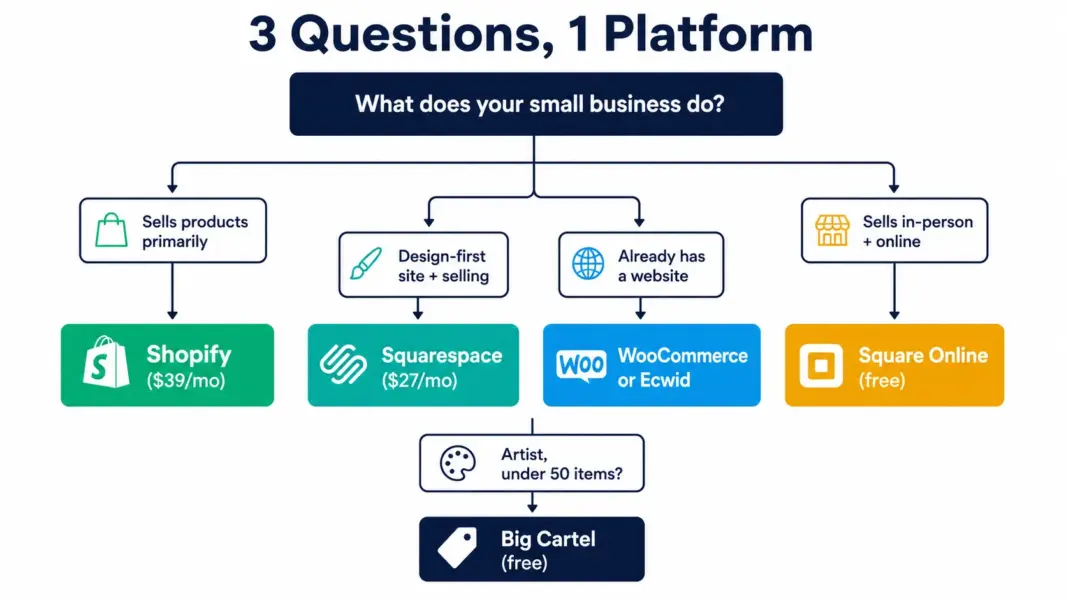
Three questions cut through platform comparisons faster than any feature table. Answer these before evaluating tools and you will eliminate 4 of 6 options immediately.
Question one: Is selling your primary business activity? If yes, choose Shopify. Its ecommerce depth and multi-channel reach are unmatched for businesses where selling drives revenue. If selling is secondary to content, services, or brand presence, Squarespace or your existing website with Ecwid may fit better.
Question two: Do you already have a website? If yes on WordPress, use WooCommerce. If yes on another platform, use Ecwid. If no, build on Shopify (for commerce-first) or Squarespace (for design-first). Starting fresh with the right platform avoids the painful migration later.
Question three: Do you sell in person and online? If yes, Square Online’s unified POS is the strongest option. Shopify POS is an alternative at higher cost. Squarespace and WooCommerce lack native POS integration and require third-party hardware.
Compare ecommerce platforms
See our full ecommerce platform guide for detailed pricing, features, and migration advice.
Last updated: July 7, 2026
Frequently Asked Questions
What is the best ecommerce platform for a small business in 2026?
Shopify is the best overall for product-focused small businesses with 8,000-plus apps and multi-channel selling. Squarespace is best for design-first businesses. WooCommerce is best for WordPress users wanting full ownership. The right choice depends on your primary business activity, existing website, and whether you sell online only or also in person.
How much does an ecommerce platform cost for a small business?
Entry costs range from free (WooCommerce plugin, Big Cartel, Square Online free plans) to $39 per month (Shopify Basic). Realistic monthly cost including apps and processing for a typical small Shopify store runs $80 to $150. Squarespace Commerce at $27 to $49 per month is cheaper all-in because it includes more features natively.
Can I start an online store for free?
Yes. Big Cartel supports 5 products free, Ecwid supports 10 products free, and Square Online offers a free plan with Square payment processing. WooCommerce’s plugin is free but requires WordPress hosting ($10-50 per month). These free options are viable for testing and small catalogs but most growing businesses eventually upgrade to paid plans for more products and features.
Is Shopify worth it for a small business?
Shopify is worth it if selling products online is your primary business activity and you plan to grow beyond a small catalog. Its multi-channel selling, app ecosystem, and ecommerce infrastructure justify the $39 per month base (plus apps). If you sell fewer than 20 products as a side function of a content site, Squarespace or Ecwid may deliver better value.
What is the cheapest ecommerce platform?
Big Cartel is the cheapest with a free plan for 5 products and no transaction fees. Square Online and Ecwid also offer free plans with limited features. Among paid platforms, Squarespace Commerce Basic at $27 per month is cheapest all-in (no platform transaction fees). Shopify at $39 per month is the cheapest among full-featured ecommerce platforms.
Should I use WooCommerce or Shopify for a small business?
Use WooCommerce if you already have a WordPress site, want full data ownership, and have the technical capacity for hosting and updates. Use Shopify if you want a managed platform that handles hosting, security, and updates for you. WooCommerce is cheaper in plugin cost but requires more technical involvement. Shopify is more expensive but easier to operate.
Related Ecommerce Guides and Comparisons
- Shopify vs Squarespace 2026
- WooCommerce Review 2026
- Squarespace Review 2026
- Best Free Ecommerce Platforms
- Complete Guide to Ecommerce Platforms