Wondering how much that recurring meeting actually costs your company? This free meeting cost calculator shows the real dollar price tag of any meeting based on who attends, how much they earn, and how long the meeting runs. Use it to justify killing low-value recurring meetings, build a business case for async alternatives, or simply shock yourself into running tighter agendas. No signup required. No email collected.
💰 Meeting Cost Calculator
👥 Meeting Setup
💵 Compensation
💡 What This Annual Spend Could Buy Instead
How to Use This Meeting Cost Calculator
Enter the number of meeting attendees, the meeting duration in minutes, and the average hourly cost per attendee. Use the toggle to switch between hourly rate or annual salary inputs. Select the meeting frequency to see annual impact for recurring meetings. The calculator instantly shows cost per meeting, annual cost if the meeting recurs, total hours consumed annually, and concrete comparisons of what that spend could buy instead.
For fully accurate cost calculation, use a fully-loaded hourly rate that includes salary plus benefits, taxes, and overhead. A $100,000 base salary typically translates to $65-75 per hour fully loaded when divided across approximately 1,800 productive work hours per year. The annual salary mode does this math automatically.
Why Most Companies Underestimate Meeting Costs
The average company underestimates meeting costs by 60-80% because they think only about salary time rather than fully-loaded employee cost. According to a 2024 Harvard Business Review analysis, the true cost of a meeting includes base salary, benefits (averaging 30% of base), employer taxes (averaging 10%), and overhead (office space, equipment, software). Failing to include these factors makes meetings look cheaper than they are.
Meeting cost compounds quickly. A weekly 1-hour meeting with 8 mid-level employees ($75 per hour fully loaded) costs $600 per meeting and $31,200 annually. Over five years, that single recurring meeting consumes $156,000 in employee time. According to a 2023 Atlassian State of Teams report, the average knowledge worker attends 17.7 hours of meetings per week, consuming 44% of their working time on coordination rather than productive work.
How to Calculate the True Cost of a Meeting
The true cost of a meeting formula is straightforward: number of attendees multiplied by meeting duration in hours multiplied by fully-loaded hourly cost per attendee. For example: 8 attendees x 1 hour x $75 per hour equals $600 per meeting. Multiply by the number of times per year the meeting recurs to find annual cost.
| Meeting Type | Typical Attendees | Duration | Per Meeting Cost | Annual Cost (Weekly) |
|---|---|---|---|---|
| Daily standup | 6 | 15 minutes | $112 | $28,125 |
| Weekly team sync | 10 | 60 minutes | $750 | $39,000 |
| Sprint planning | 8 | 2 hours | $1,200 | $62,400 |
| Sprint retrospective | 8 | 60 minutes | $600 | $31,200 |
| Quarterly all-hands | 50 | 90 minutes | $5,625 | $22,500 |
| Executive leadership meeting | 8 | 90 minutes | $1,800 | $93,600 |
These calculations assume $75 per hour fully-loaded cost for most roles and $150 per hour for executives. A 50-person organization with typical meeting patterns spends $400,000 to $600,000 annually on internal meetings, before counting the opportunity cost of work not completed during meeting hours.
What Drives Hidden Meeting Costs?
The visible cost of a meeting is the hourly cost multiplied by attendees and duration. The hidden costs are larger and often ignored. Understanding these helps you make stronger cases for replacing low-value meetings with async alternatives.
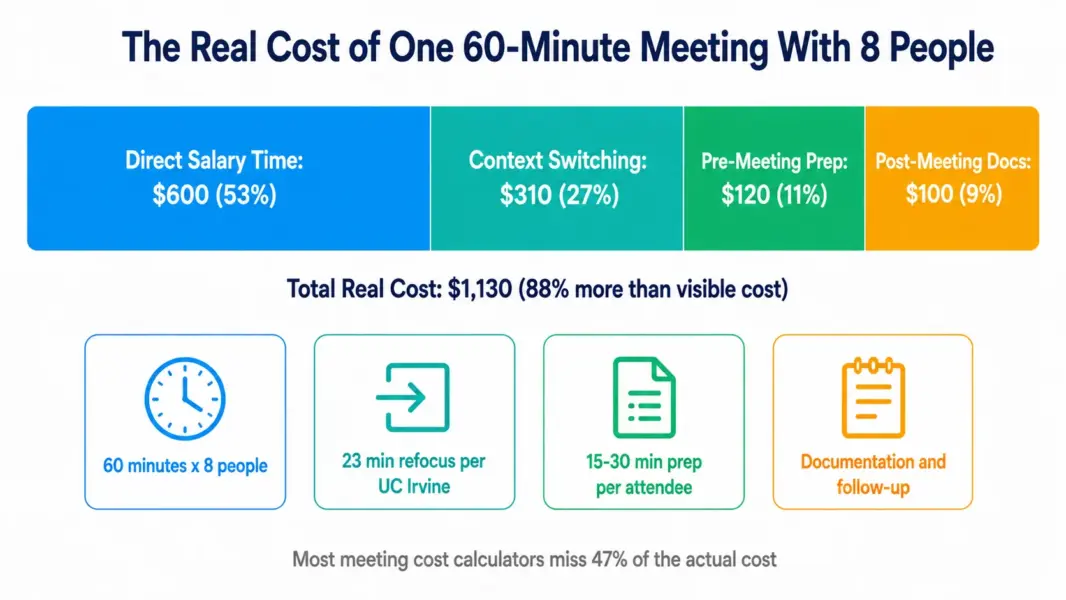
Context-switching tax: Every meeting interrupts focused work. According to a 2024 University of California Irvine study, knowledge workers need an average of 23 minutes to fully refocus after an interruption. A 30-minute meeting actually costs 53 minutes of productivity per attendee when accounting for refocus time.
Pre-meeting preparation: Status meetings typically require attendees to prepare updates, slides, or talking points. This preparation work averages 15-30 minutes per attendee per meeting according to a 2024 Atlassian workplace survey. A weekly status meeting with 10 people consumes an additional 2.5-5 hours of weekly prep time that does not appear on the calendar.
Post-meeting documentation: Decisions made in meetings need to be documented somewhere if they will be implemented. Teams without strong documentation practices either repeat the same meetings to clarify decisions or lose institutional knowledge when team members leave. Both outcomes have ongoing costs that compound over time.
Calendar fragmentation: Meetings scheduled throughout the day fragment focused work time. A workday with three 1-hour meetings spaced across morning, midday, and afternoon leaves no continuous 2-hour focused work blocks. According to research published in the Harvard Business Review in 2023, fragmented calendars reduce deep work output by 40-60% compared to calendars with batched meetings.
What Meetings Should Be Replaced With Async Alternatives?
Not every meeting needs replacing, but most companies have meetings that exist out of habit rather than necessity. Use these criteria to identify meetings worth converting to async formats.
| Replace with Async When | Keep as Meeting When |
|---|---|
| Information sharing only (status updates) | Real-time problem solving needed |
| Decisions can be made by 1-2 people | Decisions require group debate |
| Same updates every meeting | Discussion content changes each session |
| Most attendees are passive listeners | Active participation from all attendees |
| Could be summarized in writing | Visual collaboration or whiteboarding needed |
| No urgent time pressure | Time-sensitive crisis or decision |
| Recurring with predictable content | One-time or ad-hoc topic |
| Cross-time-zone team | Local team with shared hours |
The strongest candidates for async replacement are recurring status meetings, daily standups, and information broadcasts. According to a 2024 Microsoft Work Trend Index, companies that replaced recurring status meetings with written async updates reduced total meeting hours by 22% on average and increased reported employee productivity by 14%.
Tools That Replace Expensive Meetings With Async Alternatives
Several PM tools include features specifically designed to replace meetings with structured async communication. Investing in these tools delivers ROI quickly when measured against the meeting costs they eliminate.
Basecamp includes automatic check-ins that replace standup meetings entirely. Recurring questions like “What did you work on today?” send to team members on a schedule. Responses collect in a shared feed for managers to scan. According to 37signals’ published customer data, the average Basecamp customer reports eliminating 4-6 weekly meetings after adopting check-ins. See our full Basecamp review for details.
Notion reduces meeting frequency through async written collaboration. Decision logs, project status pages, and AI-powered workspace search let teams answer “where did we land on X?” questions without scheduling a meeting. See our full Notion review for details.
ClickUp includes async-friendly features like in-task chat, threaded comments, and recurring task forms that capture status updates without meetings. The Chat view consolidates team messaging with project context. See our full ClickUp review for details.
For remote teams specifically, see our best PM tools for remote teams guide covering tools optimized for async distributed work.
Find PM tools that reduce meetings
Use our PM tool picker quiz to find a platform with async features that replace expensive meetings.
Frequently Asked Questions
How accurate is this meeting cost calculator?
The calculator is accurate when you input fully-loaded employee costs. Many companies underestimate by using base hourly salary instead of fully-loaded cost, which includes benefits (approximately 30% of base), taxes (10%), and overhead. A $100,000 base salary translates to about $65-75 per hour fully loaded. The annual salary mode does this conversion automatically using 1,800 productive hours per year.
What is a fully-loaded employee cost?
Fully-loaded employee cost includes base salary, employer-paid benefits (health insurance, retirement contributions, vacation), payroll taxes (Social Security, Medicare, unemployment), and overhead allocation (office space, equipment, software, management). Total fully-loaded cost typically runs 1.3-1.4 times base salary, meaning a $100,000 base employee actually costs the company $130,000-$140,000 annually.
How much does the average meeting cost?
According to a 2024 Doodle State of Meetings report, the average business meeting costs approximately $338 per session, considering 6 attendees at $75 fully-loaded hourly rates for 45 minutes. Executive meetings cost significantly more due to higher salaries. A 90-minute meeting with 8 directors at $150 per hour fully loaded costs $1,800 per session, $93,600 annually if held weekly.
How much do meetings cost American businesses annually?
According to a 2024 Bain & Company analysis, large US enterprises spend approximately $37 billion annually on unproductive meetings. The average knowledge worker attends 17.7 hours of meetings per week according to Atlassian’s State of Teams report, with 35-40% rated as unnecessary or could have been an email. Reducing meeting time by even 20% delivers measurable productivity gains.
What is the true cost of a 30-minute meeting?
A 30-minute meeting with 8 attendees at $75 fully-loaded hourly rates costs $300 in direct salary time. Adding context-switching cost (23 minutes refocus time per attendee per UC Irvine research) brings the real cost to $530, or 76% more than the visible direct cost. The full economic cost of meetings consistently exceeds the simple time-times-rate calculation.
How can I justify reducing meetings to leadership?
Calculate the annual cost of recurring meetings using this calculator. Present three numbers: per-meeting direct cost, annual recurring cost, and what that spend could buy instead. Concrete comparisons (annual cost equals 2 mid-level salaries, 50 team subscriptions, or 10 industry conference attendances) make the business case more compelling than abstract productivity arguments alone.
Should I count my own time when calculating meeting cost?
Yes. Include yourself and every attendee in the count. If you are the meeting organizer, your time matters as much as anyone else’s in the room. Some companies discover that executive-heavy meetings cost 3-5x more than expected once leadership salaries are included properly in the calculation. This often surfaces the strongest meetings to cut first.
What is a healthy ratio of meetings to focused work?
Most productivity research suggests knowledge workers should target meetings consuming no more than 20-25% of working hours, leaving 75-80% for focused work and individual contribution. The current US knowledge worker average is 44% of time in meetings according to 2024 Atlassian data, more than double the healthy target. Companies hitting 20% meeting time report significantly higher employee satisfaction and project velocity.
Related Free Tools and Articles
- Free Team Capacity Calculator
- Free PM Tool Cost Calculator
- PM Tool Picker Quiz
- Best PM Tools for Remote Teams
- Basecamp Review (Best for Async)
- Notion Review (Best for Documentation)
- ClickUp Review (Async + Chat)
- Complete Guide to PM Software