Most teams asking Ahrefs vs Semrush are trying to answer a budget question. Both tools cost roughly $1,500 a year at their working tier, both claim to do keyword research, backlinks, audits, and rank tracking, and the feature comparison charts published by each vendor conveniently show them winning.
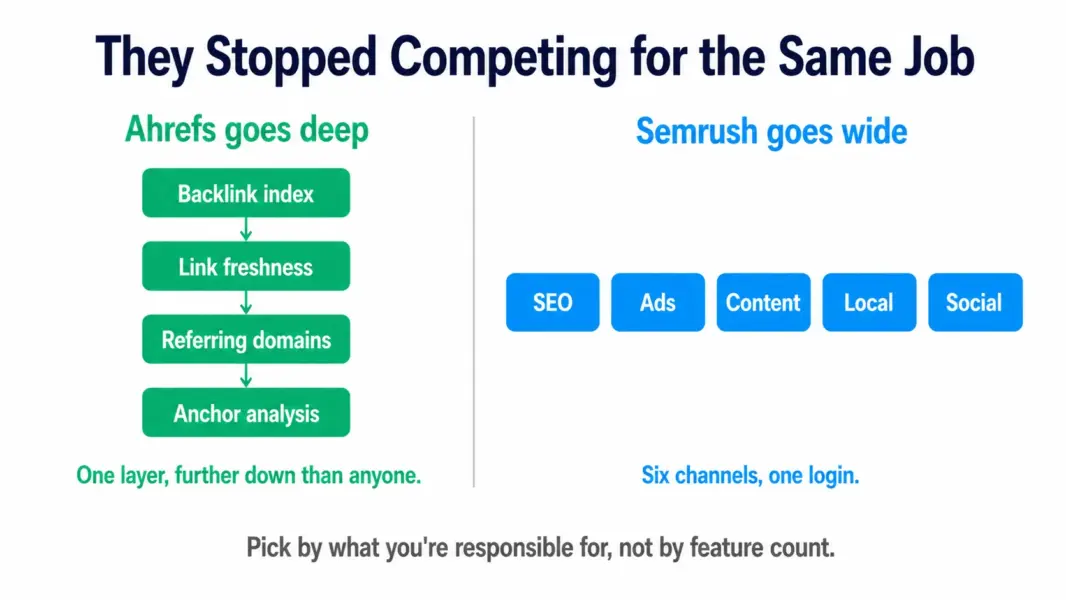
Here’s the thing those charts obscure: these tools are no longer competing for the same job. Ahrefs went deep on organic search and links. Semrush went wide across every marketing channel. A comparison that scores them feature-by-feature makes them look similar, when in practice the right choice usually becomes obvious the moment you define what you’re actually responsible for.
This comparison goes category by category with a verdict on each, then gives you a clear decision framework based on scope of work rather than feature counts.
Ahrefs vs Semrush: The Short Answer
Choose Ahrefs if backlink analysis drives your work, if you want the cleanest interface in the category, or if you need a genuinely cheap entry point at $29 per month. Best for SEO consultants, link builders, and content teams focused on organic search.
Choose Semrush if you own more than organic search. The Advertising Toolkit, local listing management, social tools, and content marketing suite have no Ahrefs equivalent. Best for marketing teams and agencies reporting across multiple channels.
Choose both if you’re an agency where link building and paid search both matter. It’s a real budget line, but plenty of agencies run Ahrefs for link data and Semrush for everything else because neither fully covers the other’s territory.
Ahrefs vs Semrush Comparison Table
| Category | Ahrefs | Semrush | Winner |
|---|---|---|---|
| Entry price | $29/mo Starter | $139/mo Pro | Ahrefs |
| Working tier | $129/mo Lite | $139/mo Pro | Tie |
| Free trial | None | 7 days plus free plan | Semrush |
| Backlink index | Largest, fastest refresh | Solid, slower updates | Ahrefs |
| Keyword database | Ten search engines | 26B+ keywords with intent | Semrush |
| Site audit | 170+ checks | 140+ checks | Tie |
| Paid search data | Basic | Full Advertising Toolkit | Semrush |
| Local SEO | None | Local Toolkit with listings | Semrush |
| Interface | Cleaner, faster to learn | Dense, powerful | Ahrefs |
| AI search tracking | Prompt tracking add-on | AI Visibility Toolkit $99/domain | Semrush |
Backlink Data: Ahrefs Wins Decisively
This is the least contested category in the comparison. Ahrefs built its business on a proprietary web crawler and the resulting link index is larger and refreshes faster than Semrush’s.
What that means practically: a link you build this week appears in Ahrefs sooner. A competitor analysis surfaces referring domains that Semrush misses. And when you’re auditing a link profile before a disavow, seeing more of the profile is straightforwardly better.
Semrush’s backlink data isn’t bad. For competitor overview work, anchor text analysis, and toxic link identification it’s entirely usable, and the Link Building Tool manages outreach prospects through a pipeline that Ahrefs doesn’t offer natively.
But if link building is a core service you deliver or a core tactic you run, the index gap is a functional difference rather than a preference. Practitioners who work links daily overwhelmingly reach for Ahrefs.
Verdict: Ahrefs, clearly.
Keyword Research: Semrush Has the Edge on Volume
Semrush’s Keyword Magic Tool draws from a database exceeding 26 billion keywords, with every term tagged by search intent. That intent classification is genuinely useful in daily work, letting you filter a research session down to commercial and transactional terms in one click.
Ahrefs’ Keywords Explorer covers ten search engines including YouTube, Amazon, and Bing, which matters if you optimise beyond Google. Two Ahrefs metrics have no Semrush equivalent: Clicks data shows how many searches actually produce a click rather than being resolved on the results page, and Parent Topic tells you whether a keyword needs its own page or can be covered by an existing one.
On difficulty scoring, the tools diverge. Semrush difficulty reads more optimistic on competitive commercial terms, while Ahrefs skews conservative. Neither is wrong. Both are directional, and neither should be treated as an absolute benchmark across platforms.
Verdict: Semrush for database size and intent filtering. Ahrefs for multi-engine coverage and smarter metrics. Slight edge to Semrush for most workflows.
Technical Site Audits: Effectively a Tie
Ahrefs Site Audit runs over 170 predefined checks covering performance, HTML tags, content quality, redirects, and JavaScript rendering. Semrush Site Audit runs 140-plus checks with results prioritised by impact.
Both crawl thoroughly, both explain issues in plain language, and both group findings by severity. Semrush edges ahead on the presentation layer with clearer prioritisation of what to fix first. Ahrefs edges ahead on crawl depth reporting and JavaScript handling.
Crawl limits differ by plan rather than by platform quality. Semrush Pro audits 100,000 pages monthly and Guru raises that to 300,000. Ahrefs allocates crawl credits by tier, with Lite covering 100,000.
Verdict: Tie. Neither tool will be the reason your technical SEO succeeds or fails.
Paid Search and Competitive Intelligence: Semrush Only
This category isn’t close because Ahrefs barely competes in it. Semrush’s Advertising Toolkit reveals which keywords competitors bid on, the ad copy they run, their estimated monthly spend, and their landing pages. The Pro tier adds AdClarity for display, video, and social ad intelligence.
Ahrefs shows competitor paid keywords in Site Explorer, and that’s roughly where it stops. No ad copy library, no spend estimation at Semrush’s depth, no display intelligence.
For an SEO specialist this gap is irrelevant. For a marketing manager who owns both organic and paid, or an agency reporting on total search performance, it’s frequently the deciding factor in the entire comparison.
Verdict: Semrush, uncontested.
Ahrefs vs Semrush Pricing Compared
Both verified against official pricing pages in July 2026.
| Tier | Ahrefs | Semrush | Notes |
|---|---|---|---|
| Entry | Starter $29/mo | Pro $139/mo | Ahrefs Starter has no Semrush equivalent |
| Working | Lite $129/mo ($108 annual) | Pro $139/mo ($117.33 annual) | Closest like-for-like comparison |
| Professional | Standard $249/mo ($208 annual) | Guru $249.95/mo | Ahrefs drops credit limits here |
| Agency | Advanced $449/mo ($374 annual) | Business $499.95/mo | Semrush adds API and Share of Voice |
| Enterprise | $1,499/mo | Custom | Both offer custom terms |
Two structural differences matter more than the headline numbers.
Ahrefs meters usage on lower plans. Starter and Lite consume credits when you open reports or apply filters. Standard and above switched to unlimited fair use. Semrush limits by results per report and projects rather than metering individual actions, which feels less restrictive during heavy research sessions on entry plans.
Both charge extra for seats. Neither headline price covers a team. Semrush charges per additional user, and Ahrefs bills additional users on a pay-as-you-go basis unless prepaid. A three-person team costs meaningfully more than the advertised rate on either platform.
Free Trials and Free Plans: Semrush Wins on Access
Semrush offers a limited free plan with a small number of daily requests across core tools, plus a 7-day free trial of paid features. You can validate the data against your own site before spending anything.
Ahrefs offers no free trial. You pay first. It does provide free Ahrefs Webmaster Tools for verified site owners, giving Site Audit and limited Site Explorer access for your own properties, which is genuinely useful but excludes the competitor research that justifies a paid plan.
The absence of an Ahrefs trial is its most consistently criticised policy, and it’s a real friction point for anyone comparing the two properly.
Verdict: Semrush, comfortably.
Ease of Use: Ahrefs Is Faster to Learn
Ahrefs presents fewer options more clearly. New users navigate confidently within about an hour, and the reports are readable without training. That clarity is a genuine competitive advantage when you’re rolling a tool out to a team or handing reports to a client.
Semrush is denser because it does more. The dashboard surfaces six toolkits, dozens of reports, and a settings surface that takes several hours to become comfortable with. Reviewers routinely describe the first sessions as overwhelming.
That density isn’t a flaw exactly, it’s the cost of breadth. But it does mean Semrush has a higher onboarding burden, and teams that don’t invest in learning it end up using a fraction of what they pay for.
Verdict: Ahrefs.
AI Search Visibility: Both Moving, Semrush Ahead
As AI Overviews and chat assistants absorb informational queries, tracking whether your brand gets cited in AI answers has become a real budget line rather than an experiment.
Semrush’s AI Visibility Toolkit tracks brand mentions across ChatGPT, Perplexity, Google AI Overviews, and Gemini, with custom prompt tracking, share of voice against competitors, and gap analysis showing prompts where rivals get cited and you don’t. It costs $99 per month per domain standalone, or comes bundled in Semrush One tiers.
Ahrefs offers prompt tracking with research across a large database of organic prompts plus custom prompt monitoring, sold as add-on packages priced by check volume.
Semrush has productised this more completely, though both are evolving quickly. If AI visibility tracking is a priority, also look at Surfer SEO, which bridges content optimisation and AI citation tracking directly.
Verdict: Semrush, for now.
Which Should You Choose: Ahrefs or Semrush?
Choose Ahrefs if you’re an SEO consultant or specialist, link building is a service you deliver, you want the cleanest interface, you need a cheap entry point at $29, or your work is purely organic search. Full detail in our Ahrefs review.
Choose Semrush if you own paid search alongside SEO, you manage local listings, you need content marketing tools, you report to clients across channels, or you want to trial before buying. Full detail in our Semrush review.
Start with neither if you’re new to SEO and haven’t exhausted Google Search Console, Analytics, and Keyword Planner. Those cover your own rankings, traffic, and volume estimates for free, and the gap they leave, competitor data, is what you should be paying to fill. See our best SEO tools for beginners guide before committing to either platform.
Last updated: July 30, 2026
Frequently Asked Questions
Is Ahrefs or Semrush better in 2026?
Ahrefs is better for backlink analysis, interface clarity, and entry pricing at $29 per month. Semrush is better for breadth, covering paid search intelligence, local SEO, social, and content tools that Ahrefs doesn’t offer. The right choice depends on whether SEO is your entire job or one channel among several.
Is Ahrefs cheaper than Semrush?
At entry, significantly. Ahrefs Starter is $29 per month versus Semrush Pro at $139. At the working tier they’re close, with Ahrefs Lite at $129 and Semrush Pro at $139. Both charge extra for additional user seats, so team pricing runs above the headline rate on either platform.
Which has better backlink data, Ahrefs or Semrush?
Ahrefs, decisively. Its proprietary crawler produces a larger index that refreshes faster, so new links appear sooner and competitor analysis surfaces more referring domains. Semrush backlink data is usable for competitor overview and disavow work but trails on index size and update speed.
Which is better for keyword research?
Semrush has the larger database at over 26 billion keywords with search intent tagging on every term. Ahrefs covers ten search engines including YouTube and Amazon, and offers Clicks data and Parent Topic, which have no Semrush equivalent. Semrush edges ahead for most standard workflows.
Does Ahrefs or Semrush have a free trial?
Semrush offers a 7-day free trial plus a limited free plan. Ahrefs offers no free trial on paid plans, only free Ahrefs Webmaster Tools for verified site owners, which covers your own site but not competitor research. This is Ahrefs’ most criticised policy.
Can I use both Ahrefs and Semrush?
Many agencies do, running Ahrefs for backlink data and Semrush for paid search intelligence, local SEO, and client reporting. It’s a substantial combined cost at roughly $270 per month at working tiers, so it only makes sense when both gaps genuinely affect your work.
Which is easier to learn, Ahrefs or Semrush?
Ahrefs. Its interface presents fewer options more clearly and most users navigate confidently within an hour. Semrush is denser because it spans six toolkits, and reviewers commonly report needing several hours before working efficiently in it.
Do I need Ahrefs or Semrush as a beginner?
Probably neither at first. Google Search Console, Analytics, and Keyword Planner cover your own rankings, traffic, and volume estimates at no cost. Once you need competitor data, which free Google tools don’t provide, Ahrefs Starter at $29 is the cheapest genuine entry point of the two.
Related SEO Guides