Both Rippling and Deel will tell you they do everything, and both are telling a version of the truth. That’s exactly what makes Rippling vs Deel confusing. They overlap enough to look like direct competitors, then diverge sharply the moment your actual situation gets specific.
Here’s the cleanest way to see the difference. Rippling was built in the US to be the single system running your whole workforce, HR, payroll, IT, and finance, tightly wired together. Deel was built to let a company hire a developer in Portugal and a designer in Argentina next Tuesday, legally, without opening an entity in either country. One consolidates. One globalizes. Your answer depends on which problem is actually yours.
This comparison works through global hiring, US payroll, HR and IT, pricing, and support with a verdict on each, then gives you a decision framework based on where your complexity really sits.
Rippling vs Deel: The Short Answer
Choose Rippling if you’re US-headquartered and want one platform running HR, payroll, IT, and finance with everything wired to a single employee record. Best for domestic-heavy teams consolidating a scattered stack.
Choose Deel if your priority is hiring internationally, managing global contractors, or running multi-country payroll, especially if you want transparent pricing and a free HRIS. Best for global-first and remote-distributed teams.
Choose based on where your complexity sits. If the hard part of your business is managing US employees, devices, and apps, that’s Rippling. If the hard part is legally employing people across borders, that’s Deel. Both are excellent at their own job.
Rippling vs Deel Comparison Table
| Factor | Rippling | Deel | Winner |
|---|---|---|---|
| Best at | US HR + IT + payroll unified | Global hiring and EOR | Depends |
| Entry price | $8/user + $35 base + modules | Free HRIS, EOR from $599 | Deel (transparency) |
| EOR coverage | 80 countries | 130-150+ countries | Deel |
| US payroll | Best-in-class, native engine | Good enough, native | Rippling |
| Contractor management | Bundled in plan | Free, or $49/mo paid tier | Tie |
| IT / device management | Built-in, strong | Limited | Rippling |
| Free tier | None (6mo free for startups) | Free HRIS unlimited | Deel |
| Pricing transparency | Quote-based, opaque | Published EOR and module rates | Deel |
| G2 rating | ~4.7-4.9 | ~4.5-4.8 | Close |
Category First: Workforce OS vs Global Hiring Platform
This distinction resolves most of the comparison, so it leads. Rippling and Deel started from opposite ends and grew toward each other.
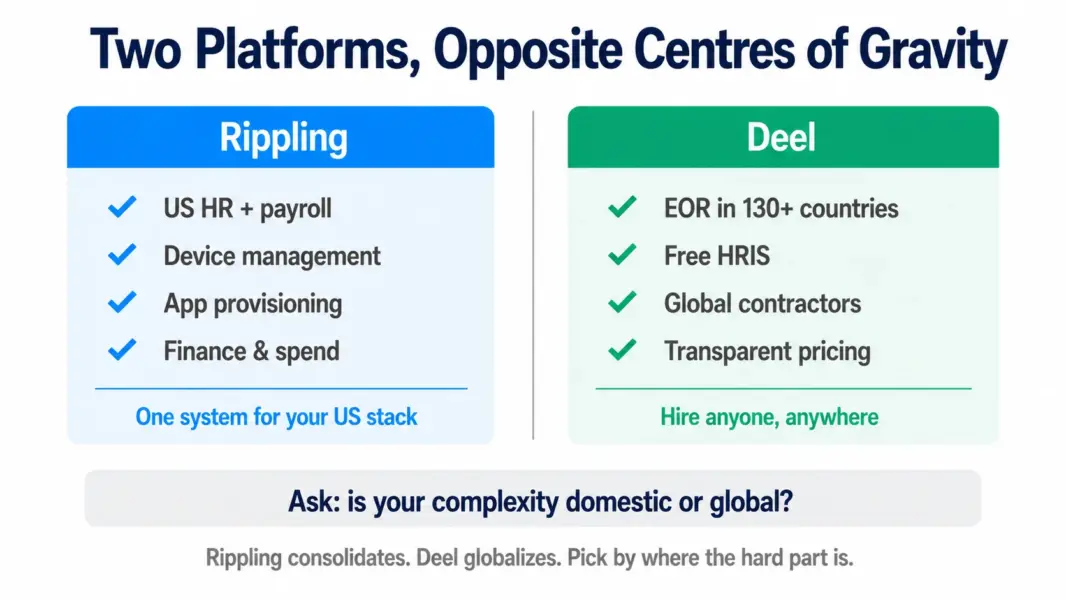
Rippling is a workforce operating system. It began as HR and payroll and expanded into IT (device and app management) and finance (spend, corporate cards, now business banking). The core idea is one employee record driving every function, so onboarding someone provisions their payroll, benefits, laptop, and app access in one workflow. Its center of gravity is US-domestic operations, and it’s the platform of record for your whole company.
Deel is a global hiring platform. It began with contractor payments and EOR, letting companies legally employ people in countries where they have no entity, and added a free HRIS and light IT on top. Its center of gravity is international employment and compliance. It works alongside your existing stack rather than replacing it.
The practical test: if you asked “how do I manage laptops and payroll for my 100 US employees in one system,” Rippling has the better answer. If you asked “how do I hire and pay someone in Poland next week,” Deel does. Name your real question and the choice narrows fast.
Global Hiring and EOR: Deel Wins
For hiring internationally without a local entity, Deel is the stronger platform, and the numbers show why.
Deel offers EOR in 130-plus countries (some sources cite 150-plus), with much of that on owned entities rather than third-party partners, which gives more consistent compliance and service. Onboarding is fast, contractor breadth spans 185-plus countries, and pricing is transparent at $599 per employee per month for EOR with no minimum and month-to-month terms available.
Rippling supports EOR in around 80 countries, largely through local partners, with native payroll in a smaller set. It’s genuinely capable for companies whose global hiring is a secondary function bolted onto a US-centric operation, but it doesn’t match Deel’s coverage or owned-entity depth.
Deel has also taken the top spot in G2’s multi-country payroll category, a position Rippling previously held, reflecting the market’s view that Deel leads on global. For a company where international hiring is the core need, Deel is the safer choice.
Verdict: Deel, clearly, for global reach and compliance depth.
US Payroll and Domestic Operations: Rippling Wins
Flip to US-domestic payroll and the advantage reverses. Rippling’s native US payroll engine automates federal, state, and local tax filings, syncs in real time with HR and time tracking, and is consistently rated above 9.0 on G2 for payroll performance. Rippling markets running payroll in 90 seconds, and for a US-heavy operation that automation is real.
Deel offers native US payroll and a US PEO product, but reviewers and analysts consistently describe its US-specific automation as “good enough” rather than best-in-class. Rippling has a multi-year head start on US-domestic workflow depth, and it shows in multi-state tax handling and the tightness of the HR-to-payroll-to-IT data sync.
For a US-headquartered company running domestic payroll as its primary need, Rippling is the stronger engine.
Verdict: Rippling, for US payroll depth and automation.
HR, IT, and the Unified Platform: Rippling Wins on Breadth
This is Rippling’s signature strength. Because one employee record drives HR, payroll, IT, and finance, Rippling can do things neither Deel nor most competitors attempt: provision a new hire’s laptop, install required software, grant app access, enroll benefits, and set up payroll from a single onboarding flow. Offboarding reverses it all in one action, which is a genuine security benefit.
Its IT module handles device management and app provisioning at a depth Deel doesn’t approach. Deel has added light IT and device management, but it’s a supporting feature, not a core competency.
Deel’s HRIS, by contrast, is free and genuinely useful for records, PTO, and org charts, but it’s designed to get you into the Deel ecosystem for global hiring rather than to run deep US IT and HR operations.
Verdict: Rippling, for unified HR, IT, and finance breadth. Deel wins only on the free HRIS entry point.
Rippling vs Deel Pricing Compared
Verified against official and current sources in July 2026. The two price on completely different models.
| Aspect | Rippling | Deel | Note |
|---|---|---|---|
| Base platform | $8/user + $35/mo base fee | Free HRIS | Deel free to start |
| US payroll | ~$35/user module | Native, quote | Rippling module stacks |
| EOR | ~$499/employee (est) | $599/employee published | Deel transparent, no minimum |
| Contractor | Bundled in plan | Free, or $49/mo paid | Rippling bundles it |
| Global payroll | Module | $29/employee (existing entity) | Deel published |
| Real-world HR+payroll+IT | $25-60+/employee | Varies by module | Rippling stacks fast |
The structural difference matters more than any single number. Rippling’s modular pricing is quote-based and opaque, with a $35 base fee plus $8 per user for the platform, then each module (payroll, IT, benefits) stacking its own per-employee charge. Most teams running HR plus payroll land at $25 to $35 per employee, and adding IT pushes past $60. Implementation fees range from $1,500 to $20,000.
Deel publishes its core rates: free HRIS, EOR from $599, global payroll at $29, contractor at $49. That transparency lets you budget before talking to sales, which Rippling’s model doesn’t. Model your specific configuration with our payroll cost calculator.
Verdict: Deel, for pricing transparency and a free entry point. Rippling’s value is real but harder to predict.
Support and Ease of Use: Close, With Different Strengths
Both rate highly. Rippling scores around 4.7 to 4.9 across G2 and Capterra, praised for its unified platform and automation, with a UX rating that edges Deel’s. Deel scores around 4.5 to 4.8, praised for ease of use, fast implementation, and 24/7 support via chat, email, and phone.
The practical difference: Deel is faster to implement and easier to learn, with a lighter footprint since it works alongside your stack. Rippling’s implementation is heavier because it’s becoming your system of record, which unlocks more automation but demands more setup effort. Reviewers note Rippling’s support can be slower, while Deel’s is more responsive but chat-and-ticket led.
Verdict: Close. Deel for faster onboarding and responsive support, Rippling for depth once configured.
Which Should You Choose: Rippling or Deel?
Choose Rippling if you’re US-headquartered, want to consolidate HR, payroll, IT, and finance into one system of record, run domestic payroll as a primary need, or value device and app management alongside HR. Its value compresses if you already run a separate HRIS. See our best HR software guide.
Choose Deel if you hire internationally, manage global contractors, need EOR in many countries, want transparent pricing, or want a free HRIS to start. It works alongside your existing stack rather than replacing it, which suits global-first teams.
The deciding questions: Is your complexity domestic (US employees, devices, apps) or global (hiring across borders)? Domestic consolidation points to Rippling. International hiring points to Deel. Are you replacing your whole stack or adding global capability to it? Replacing means Rippling, adding means Deel. For the full HR landscape including BambooHR and Gusto, see our best HR software for small business guide and BambooHR vs Gusto comparison.
Last updated: August 2, 2026
Frequently Asked Questions
Is Rippling or Deel better in 2026?
They excel at different jobs. Rippling is better for US-headquartered companies wanting to unify HR, payroll, IT, and finance in one system, with best-in-class US payroll. Deel is better for international hiring, with EOR in 130-plus countries, a free HRIS, and transparent pricing. Choose Rippling to consolidate your US stack, Deel to hire globally.
Is Rippling or Deel cheaper?
Deel is cheaper to start, with a free HRIS and published EOR pricing from $599 per employee. Rippling requires a $35 base fee plus $8 per user plus stacking modules, landing most teams at $25 to $60 per employee once payroll and IT are added. Deel’s transparent pricing also makes budgeting easier than Rippling’s quote-based model.
Which has better global EOR coverage, Rippling or Deel?
Deel, substantially. Deel offers EOR in 130-plus countries, much of it on owned entities, versus Rippling’s roughly 80 countries largely through local partners. Deel also holds the top spot in G2’s multi-country payroll category. For international hiring as a primary need, Deel’s coverage and owned-entity model lead.
Which is better for US payroll, Rippling or Deel?
Rippling. Its native US payroll engine automates federal, state, and local tax filings, syncs in real time with HR and IT, and rates above 9.0 on G2 for payroll performance. Deel offers native US payroll too, but its US-specific automation is generally considered good enough rather than best-in-class.
Which is better for startups, Rippling or Deel?
It depends on the startup. Global-first startups with distributed teams and contractors should start with Deel, especially given its free HRIS. US-headquartered startups wanting a unified HR, IT, and payroll system as they grow lean toward Rippling, which also offers six months free for first-round startups.
Does Rippling or Deel have a free plan?
Deel offers a genuinely free HRIS for unlimited employees, covering records, PTO, and org charts. Rippling has no free tier, though it offers six months free for first-round startups and a 14-day trial for its IT module. For a free starting point, Deel is the clear choice.
Can Rippling and Deel work together?
They can coexist, with some companies running Rippling as their US system of record and Deel for international EOR, though this creates two systems to manage. More often it’s an either-or decision. Deel is designed to work alongside an existing HRIS, while Rippling aims to be the single platform, so pairing them somewhat undercuts Rippling’s consolidation value.
Which is better for international contractors?
Both are strong. Deel offers free contractor management or a $49 per month paid tier with contractor support in 185-plus countries, and built its reputation on contractor payments. Rippling bundles contractor management into its plan, which can save money for contractor-heavy teams already on Rippling. For contractors as a primary need, Deel’s breadth leads.
Related HR and Payroll Guides
- Best HR Software for Small Business
- BambooHR vs Gusto 2026
- Gusto Review 2026
- Best Payroll Software for Small Business
- Payroll Cost Calculator