Pros
- Widest toolset in SEO covering keywords backlinks technical audits content ads and social
- Keyword Magic Tool holds over 26 billion keywords with intent tagging on every term
- Position Tracking updates daily and supports multiple locations and devices on Guru
- Site Audit checks 140-plus technical issues and prioritises them by impact
- Advertising Toolkit reveals competitor paid keywords ad copy and estimated spend
- AI Visibility Toolkit tracks brand mentions across ChatGPT Perplexity and Google AI Overviews
- Free plan and 7-day trial let you validate the data before committing
- Historical data back to January 2012 on Guru and above
Cons
- Pro at 139 dollars monthly is expensive for solo bloggers and small sites
- Guru at 249 dollars is the realistic plan for agencies which doubles the entry cost
- Backlink index is smaller and slower to update than Ahrefs for link-focused work
- Every user seat costs extra so a three person team pays well above the headline price
- Interface density means new users need several hours before they work efficiently
- AI Visibility Toolkit is a separate 99 dollar per domain add-on not bundled with SEO plans
- Keyword difficulty scores skew optimistic compared with Ahrefs on competitive terms
Here’s the situation most marketing teams recognise. Someone owns SEO and uses one tool. Someone owns paid search and uses another. A third person writes content and optimises it somewhere else entirely. Nobody can answer a simple question like “are we bidding on keywords we already rank for organically,” because the data lives in three places that don’t talk.
Semrush was built to collapse that. One login covering organic search, paid search, content, technical health, local listings, and now AI search visibility, all reading from the same keyword database so the numbers actually reconcile.
That breadth is the entire argument, and it’s also the catch. This Semrush review covers what the platform genuinely does well, where Ahrefs beats it, what every plan costs, and the specific point at which paying for six toolkits to use two stops making sense.
Starting Price: $139/mo Pro ($117.33 annual) | Free Plan: Yes (limited) | Free Trial: 7 days
What Is Semrush and Who Actually Uses It
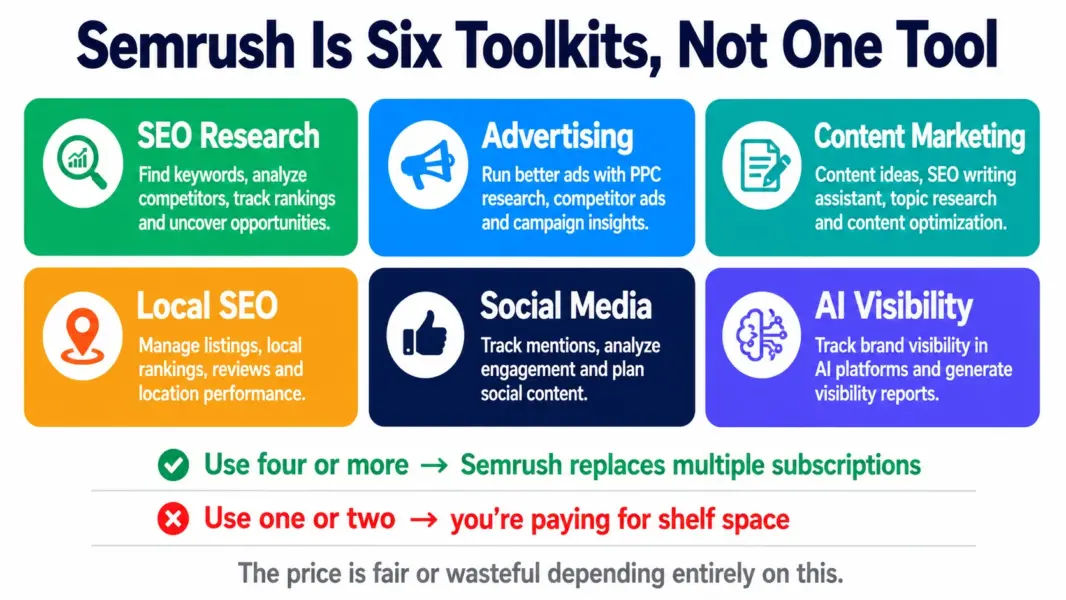
Semrush is a marketing visibility platform organised into toolkits rather than a single SEO tool. The SEO Toolkit is the core, covering keyword research, rank tracking, backlink analysis, technical audits, and competitor research. Separate toolkits handle advertising research, content marketing, local SEO, social media, and AI search visibility.
That structure matters when you’re comparing pricing, because Semrush sells access by toolkit and tier rather than as one flat product. Buying the SEO Toolkit doesn’t get you AI Visibility, and the newer Semrush One bundles exist specifically to combine them.
The typical Semrush customer isn’t a solo blogger. It’s a marketing team or agency where one person researches keywords, another buys ads, and someone reports on both. Solo site owners exist on the platform but frequently pay for capability they never open.
Semrush Features Tested: What You Actually Get
Keyword Magic Tool and Keyword Research
The Keyword Magic Tool draws on a database exceeding 26 billion keywords. Enter a seed term and you get grouped variations, questions, and related phrases, each tagged with search volume, keyword difficulty, cost per click, competitive density, and search intent.
Intent tagging is the feature that changes daily workflow. Every keyword is classified as informational, navigational, commercial, or transactional, which lets you filter an entire research session down to terms with buying intent in one click instead of eyeballing a list of two thousand phrases.
The honest caveat: Semrush keyword difficulty scores tend to read more optimistic than Ahrefs on competitive commercial terms. Treat difficulty as directional across both tools rather than absolute.
Position Tracking and Rank Monitoring
Position Tracking updates daily rather than weekly, which matters when you’re validating whether a change actually moved anything. Pro covers 500 tracked keywords, Guru raises that to 1,500, and Business goes higher again.
Guru adds multi-location and multi-device tracking within a single project, up to 10 combinations. For a business with offices in four cities, that means seeing rankings city by city rather than averaging them into a number that describes nowhere.
Site Audit and Technical SEO
Site Audit crawls your site against 140-plus technical checks covering crawlability, indexation, HTTPS, Core Web Vitals, internal linking, duplicate content, and structured data. Results arrive prioritised by impact rather than dumped as a flat list, which is the difference between a report you act on and one you archive.
Crawl limits scale by plan: 100,000 pages monthly on Pro, 300,000 on Guru. For most sites Pro’s allocation is generous. For large ecommerce catalogues it isn’t.
Backlink Analytics and Link Building
Semrush backlink data covers referring domains, anchor text distribution, authority scores, and toxic link identification, with a Link Building Tool that manages outreach prospects through a pipeline.
This is where Ahrefs holds a genuine advantage. Ahrefs’ backlink index is larger and refreshes faster, and link-focused practitioners consistently prefer it. Semrush’s link data is entirely usable for competitor analysis and disavow work, but if backlinks are the centre of your practice rather than one input among many, that gap is worth weighing. Our Ahrefs vs Semrush comparison breaks this down properly.
Advertising Toolkit: The Underrated Differentiator
The Advertising Toolkit shows which keywords competitors bid on, the ad copy they run, their estimated monthly spend, and their landing pages. The Pro tier of this toolkit adds AdClarity for display, video, and social ad intelligence.
No dedicated SEO tool offers this. If your organisation runs paid search alongside organic, this single toolkit can replace a separate competitive intelligence subscription and is frequently the reason teams choose Semrush over Ahrefs despite the link data gap.
AI Visibility Toolkit
Semrush’s AI Visibility Toolkit tracks how your brand appears inside AI-generated answers across ChatGPT, Perplexity, Google AI Overviews, and Gemini. You track custom prompts, monitor share of voice against competitors, and identify prompts where rivals get cited and you don’t.
It’s sold as a separate $99 per month per domain subscription, or bundled into Semrush One tiers. As AI search takes a growing share of informational queries, this category is becoming a real budget line rather than an experiment, and Semrush is ahead of most competitors in productising it.
Semrush Pricing Plans and What Each Tier Unlocks
Verified against Semrush’s official pricing pages in July 2026. Annual billing saves up to 17%.
| Plan | Monthly | Annual | Key Limits |
|---|---|---|---|
| Pro | $139.00 | $117.33/mo | 5 projects, 500 tracked keywords, 100,000 pages audited, 10,000 results per report |
| Guru | $249.95 | Discounted annually | 1,500 keywords, 300,000 pages, 30,000 results per report, historical data, multi-location tracking |
| Business | $499.95 | Discounted annually | Share of Voice, API access, extended limits, agency-scale reporting |
| AI Visibility | $99 per domain | Billed annually | 25 tracked prompts, daily AI rankings, brand performance analysis |
Semrush One bundles the SEO and AI Visibility toolkits into single subscriptions: Starter matches Pro limits, Pro+ matches Guru limits at roughly $248.17 per month annually, and Advanced matches Business limits at roughly $416.66 per month annually. If you want both toolkits, the bundle beats buying them separately.
The cost most people miss is seats. Additional users are charged on top of the plan, so a three-person team pays meaningfully more than the headline figure. Budget for seats before comparing Semrush against per-seat-inclusive alternatives.
Pro vs Guru: Which Plan Do You Actually Need?
Pro at $139 covers a single site or a small portfolio properly: keyword research, daily rank tracking for 500 terms, technical audits, and competitor analysis.
Guru at $249.95 exists for three specific reasons. Historical data back to January 2012, which lets you see how a keyword’s volume and a competitor’s rankings shifted over years rather than weeks. Multi-location tracking for businesses serving several cities. And the Content Marketing Toolkit with topic research and SEO writing assistance.
If none of those three describe your work, Pro is sufficient and the $110 monthly difference belongs elsewhere. Agencies almost always need Guru. Single-site owners usually don’t.
What Real Users Say About Semrush
Semrush is consistently rated among the strongest platforms in its category on G2 and Capterra, with reviewers highlighting data breadth, the Keyword Magic Tool, and reporting quality as standout strengths. Agencies in particular credit the white-label reporting and the ability to run client SEO and PPC research from one place.
Three criticisms recur. Price is the dominant one, with reviewers noting that Guru-level access plus additional seats pushes annual spend past what small agencies budget for tooling. Interface complexity is second, with new users describing the dashboard as overwhelming until they’ve spent several hours in it. Third, reviewers who work primarily on link building consistently note that Semrush’s backlink index trails Ahrefs in both size and refresh speed.
Semrush Pros and Cons After Real Use
Where Semrush Genuinely Wins
Breadth without switching tools. Organic research, paid competitor intelligence, technical auditing, content optimisation, local listings, and AI visibility read from one dataset, so the numbers in your report reconcile.
Competitor paid search intelligence. Nothing in the dedicated SEO category matches the Advertising Toolkit, and for teams running both channels it’s often the deciding feature.
Reporting for clients. White-label PDF reports, scheduled delivery, and My Reports templating are built for agencies presenting to non-technical stakeholders.
Where Semrush Falls Short
Backlink depth. Ahrefs indexes more links and updates faster. For link-led SEO practices this is a real functional gap, not a preference.
Cost for narrow use. Paying $139 to use two of six toolkits is poor value, and cheaper focused tools serve solo site owners better.
Seat economics. Per-user charges on top of plan pricing make small teams noticeably more expensive than the advertised rate suggests.
Learning curve. Expect several hours before the interface stops slowing you down, which is a real onboarding cost when rolling it out to a team.
Best Semrush Alternatives Worth Considering
Ahrefs ($29 to $449 per month). Larger and faster backlink index, cleaner interface, and a $29 Starter plan that undercuts Semrush’s entry point substantially. Weaker on paid search intelligence and local SEO. See our Ahrefs review.
Surfer SEO ($79 to $175 per month). Not a Semrush replacement but a complement. Surfer handles on-page content optimisation and AI visibility tracking in depth, and many teams run it alongside a research platform. Our Surfer SEO review covers where it fits.
Free tools. Google Search Console, Google Analytics, and Google Keyword Planner cover rank data, traffic, and volume estimates at zero cost. They’re less convenient and lack competitor data, but they’re the correct starting point before paying anything. See our best SEO tools for beginners guide.
Is Semrush Worth It? Final Verdict
Semrush is worth its price when your work spans multiple channels. A marketing team running SEO, paid search, and content, or an agency reporting across all three for clients, gets genuine consolidation value that justifies Guru pricing. In that context Semrush replaces two or three subscriptions and the cost comparison flips in its favour.
It’s poor value when your work is narrow. A solo blogger doing keyword research and occasional rank checks is paying for advertising intelligence, local listings, and social tools they’ll never open. Ahrefs Starter at $29 or free Google tools serve that use case far better.
Practical path: run the 7-day trial against your actual workflow rather than exploring features. Note which toolkits you open more than twice. If the answer is one or two, buy something cheaper. If it’s four or more, Semrush is doing exactly what it’s designed to do.
Last updated: July 28, 2026
Frequently Asked Questions
How much does Semrush cost in 2026?
The SEO Toolkit runs Pro at $139 per month ($117.33 billed annually), Guru at $249.95, and Business at $499.95. The AI Visibility Toolkit is $99 per month per domain. Semrush One bundles SEO and AI Visibility across Starter, Pro+, and Advanced tiers. Additional user seats cost extra on every plan.
Is Semrush better than Ahrefs?
They win on different things. Semrush is better for teams running SEO alongside paid search, content, and local listings because of its toolkit breadth. Ahrefs is better for backlink analysis, with a larger and faster-updating link index, and its $29 Starter plan is far cheaper to begin with. Choose by scope of work.
Does Semrush have a free plan?
Yes, a limited free plan with a small number of daily requests across core tools. It’s enough to check a handful of keywords or run a basic domain lookup, not to do sustained work. A 7-day free trial of paid features is also available.
What is the difference between Semrush Pro and Guru?
Guru adds historical data back to January 2012, multi-location and multi-device rank tracking, the Content Marketing Toolkit, and higher limits at 1,500 tracked keywords and 300,000 pages audited versus Pro’s 500 and 100,000. If you don’t need historical data or multi-location tracking, Pro is sufficient.
Is Semrush worth it for a small business?
Only if you use more than two toolkits. A single-site business doing keyword research and rank tracking is overpaying at $139 per month. Ahrefs Starter at $29 or free Google tools cover that need. Semrush earns its price when SEO, paid search, and content all run through it.
Does Semrush track AI search visibility?
Yes. The AI Visibility Toolkit tracks brand mentions across ChatGPT, Perplexity, Google AI Overviews, and Gemini, monitoring custom prompts and share of voice against competitors. It costs $99 per month per domain as a standalone subscription or comes bundled in Semrush One plans.
How accurate is Semrush keyword difficulty?
Directionally useful but not absolute. Semrush difficulty scores tend to read more optimistic than Ahrefs on competitive commercial terms. Use difficulty to compare keywords within one tool rather than treating the number as a fixed benchmark across platforms.
Can I cancel Semrush anytime?
Yes, you can cancel, upgrade, or downgrade at any time unless you’re on custom enterprise terms with a signed agreement. Annual subscriptions are billed as a single upfront payment for the full year, so cancellation stops renewal rather than refunding the remaining term.
Related SEO Guides
Semrush is the most complete marketing platform in SEO, and that breadth is both the reason to buy it and the reason it costs what it does. Nothing else covers keyword research, technical auditing, content optimisation, competitor paid ads, local listings, and AI search visibility inside one login. If your work spans SEO plus PPC plus content, Semrush replaces three subscriptions and the price stops looking steep. If you only need backlink analysis and keyword research, you are paying for six toolkits to use two, and Ahrefs delivers better link data for less. The honest dividing line is scope of work, not data quality.