Pros
- Largest and fastest-updating backlink index of any SEO platform
- Starter plan at 29 dollars is the cheapest genuine entry point among major SEO tools
- Standard plan and above removed credit limits entirely in favour of fair use
- Site Explorer gives the clearest competitor traffic and link picture in the category
- Keywords Explorer covers ten search engines including YouTube Amazon and Bing
- Content Explorer surfaces proven topics by traffic and referring domains
- Free Ahrefs Webmaster Tools gives site owners audits and link data at no cost
- Clean interface that new users navigate confidently within an hour
Cons
- No free trial so you pay before you can properly evaluate the platform
- Lite at 129 dollars jumps sharply from the 29 dollar Starter plan
- Starter plan blocks add-on purchases and cannot be downgraded to from higher tiers
- Credit system on Starter and Lite makes heavy research sessions feel rationed
- Weaker paid search and advertising intelligence than Semrush
- No native social media or local listing management tools
- Additional users and AI prompt tracking are billed as separate add-ons
You publish a genuinely better article than the page ranking above you. Better research, clearer structure, more useful examples. Six months later it’s still on page two and the thinner competitor hasn’t moved.
The reason is almost always links, and you can’t fix what you can’t see. Understanding which sites point at that competitor, which pages earned those links, and which of those sites might plausibly link to you is the work Ahrefs exists to do, and it does it with a bigger and fresher link index than anything else on the market.
This Ahrefs review covers what the platform does, how the restructured 2026 pricing actually works, where it beats Semrush, where it clearly loses, and whether the $29 Starter plan is a genuine entry point or a teaser.
Starting Price: $29/mo Starter | $129/mo Lite ($108 annual) | Free Plan: Yes (Webmaster Tools) | Free Trial: No
What Is Ahrefs and Who Is It Built For
Ahrefs is an SEO platform built around a proprietary web crawler that indexes links. That crawler is the foundation everything else sits on, and it’s why the platform’s identity is so tightly bound to backlink data.
The toolset covers five core areas: Site Explorer for analysing any domain’s traffic and links, Keywords Explorer for research across ten search engines, Site Audit for technical health, Content Explorer for finding proven topics, and Rank Tracker for monitoring positions.
The typical Ahrefs user is doing organic search work specifically: an SEO consultant analysing why competitors rank, a content team finding topics with link potential, an in-house specialist auditing technical health. Teams that also need paid search intelligence, social scheduling, or local listing management will find those gaps immediately, because Ahrefs doesn’t attempt them.
Ahrefs Features Tested: What You Actually Get
Site Explorer and the Backlink Index
Site Explorer is the tool people buy Ahrefs for. Enter any domain or URL and you see estimated organic traffic, ranking keywords, referring domains, individual backlinks with anchor text, top-performing pages, and paid keyword data.
The backlink index is the differentiator. Ahrefs crawls the web continuously and its link database is larger and refreshes faster than competitors. In practice that means a link built this week shows up sooner, and a competitor analysis surfaces links that other tools miss entirely.
The workflow that makes this valuable: run a competitor through Site Explorer, sort their top pages by referring domains, and you have a ranked list of the content that actually earns links in your niche. That single report answers more strategy questions than most keyword research sessions.
Keywords Explorer
Keywords Explorer covers ten search engines including Google, YouTube, Amazon, Bing, Baidu, and Yandex. Each keyword returns search volume, keyword difficulty, clicks, click-through rate distribution, return rate, and parent topic.
Two metrics here are genuinely differentiated. Clicks data shows how many searches actually result in a click rather than being answered on the results page, which matters enormously now that AI Overviews absorb informational queries. Parent Topic tells you whether a keyword can be targeted with an existing page or genuinely needs its own, which prevents the cannibalisation that comes from building a page per keyword.
Site Audit
Site Audit crawls your site and reports on over 170 predefined SEO issues covering performance, HTML tags, social tags, content quality, localisation, incoming and outgoing links, redirects, and JavaScript rendering.
Reports are grouped by severity with clear explanations of why each issue matters, which makes the output usable by someone who isn’t a technical SEO. Site Audit doesn’t consume credits on any plan, so you can crawl as often as your plan’s page limit allows.
Content Explorer
Content Explorer searches a database of billions of web pages by topic, filtered by organic traffic, referring domains, social shares, publication date, and language. It’s the fastest way to answer “what content in this space actually earns links” before you commit to writing anything.
Practical use: filter for pages with high referring domains but declining traffic, and you’ve found outdated content ranking on link equity alone. That’s the clearest content opportunity signal available in any tool.
Rank Tracker
Rank Tracker monitors keyword positions across locations and devices with scheduled reporting. Like Site Audit, it doesn’t consume credits. Tracked keyword limits scale by plan, with Lite covering 750 keywords.
The Share of Voice metric is worth noting: rather than reporting positions in isolation, it estimates what proportion of total available clicks in your tracked keyword set you’re actually capturing, which is a far more honest measure of visibility than an average position number.
Ahrefs Pricing Explained: Credits, Fair Use, and Five Tiers
Ahrefs restructured pricing substantially, and any comparison written before mid-2024 is describing a different product. Verified against Ahrefs’ official pricing page in July 2026.
| Plan | Monthly | Annual | Usage Model |
|---|---|---|---|
| Starter | $29 | Monthly only | 100 credits per month, no add-ons, no extra users |
| Lite | $129 | $108/mo | Credit-based, 5 projects, 750 tracked keywords, 6 months history |
| Standard | $249 | $208/mo | Unlimited fair use, more Site Explorer reports |
| Advanced | $449 | $374/mo | Unlimited fair use, agency directory listing eligibility |
| Enterprise | $1,499 | $1,499/mo | Custom limits, wire transfer billing, dedicated support |
Annual billing works out to paying for 10 months and receiving 12, roughly a 17% discount. Ahrefs states plainly that it never runs promotional discounts, so the annual commitment is the only saving available.
How Ahrefs Credits Work
This is the detail that confuses new buyers most, and getting it wrong leads to a frustrating first month.
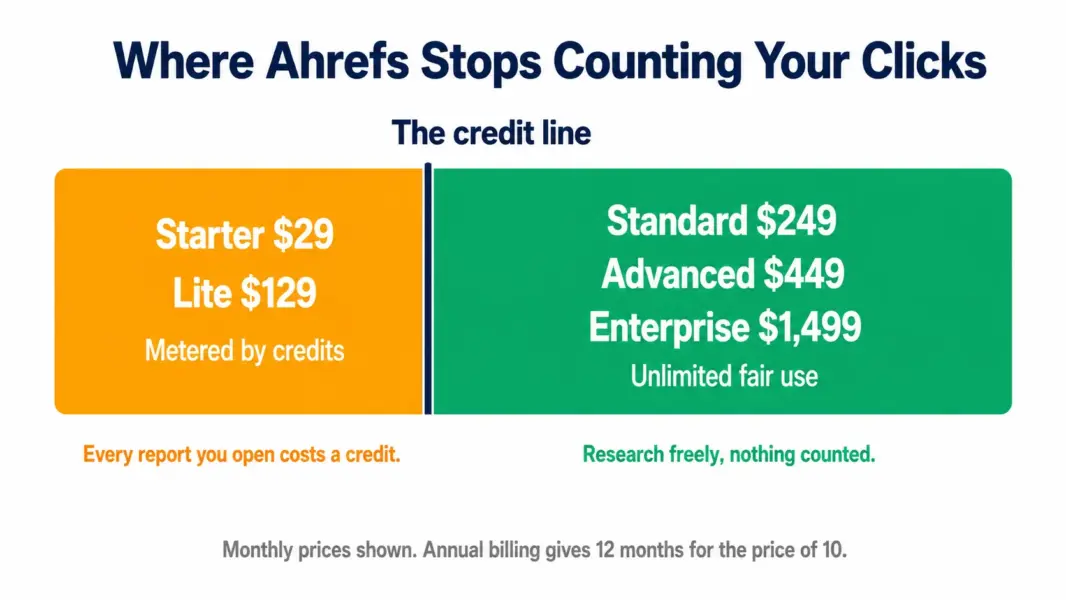
Credits apply only to the Starter and Lite plans. One credit is consumed each time you open a report, apply a filter and click show results, change a date range, open the SERP viewer, or add a competitor to a chart. Site Audit and Rank Tracker never consume credits because they have their own separate limits.
Starter includes 100 credits monthly and blocks the purchase of additional ones. Lite includes more, and additional credits can be bought at $50 per 500 billed monthly, or prepaid at $300 yearly for an extra 500 per month.
Standard, Advanced, and Enterprise removed credits entirely in favour of unlimited fair use, meaning normal research work isn’t metered at all. Ahrefs reserves the right to throttle automated or abusive usage, but everyday exploring, filtering, and reporting isn’t counted. Ahrefs’ own data indicates only about 20% of paid users ever needed additional credits.
Is the $29 Starter Plan Actually Useful?
Genuinely, for a specific person. Starter gives access to Site Explorer, Keywords Explorer, and Site Audit with 100 monthly credits, which supports roughly 100 report loads. For a beginner running a handful of competitor checks and keyword sessions each month, that’s workable.
The restrictions are real. You cannot buy additional credits, cannot add users, and cannot downgrade to Starter from a higher plan later. It’s an on-ramp, not a long-term home, and heavy research sessions will exhaust 100 credits faster than you expect.
Ahrefs Free Tools
Ahrefs Webmaster Tools is free for verified site owners and includes Site Audit plus limited Site Explorer access for your own properties. Ahrefs also publishes free public tools including a backlink checker, keyword generator, and SERP checker with limited daily use.
For a site owner who only needs to audit and monitor their own site, Webmaster Tools covers a surprising amount at zero cost. Competitor research is what forces the upgrade.
What Real Users Say About Ahrefs
Ahrefs sits among the highest-rated SEO platforms on G2 and Capterra, with reviewers consistently naming backlink data quality and interface clarity as its strongest attributes. SEO professionals frequently describe Site Explorer as the tool they’d keep if forced to choose one.
Three complaints recur. Pricing is the loudest, with reviewers noting that Lite at $129 is a steep jump from Starter and that agency-scale plans reach $2,400 or more annually. The absence of a free trial draws consistent criticism, since evaluating properly means paying first. Credit anxiety on lower plans is the third theme, with reviewers describing hesitation to explore data freely for fear of burning quota, which is precisely what the Standard-tier fair use model was introduced to fix.
Ahrefs Pros and Cons After Real Use
Where Ahrefs Genuinely Wins
Backlink data quality and freshness. This isn’t a close call. If link analysis is central to your work, Ahrefs is the correct tool and the discussion ends there.
Interface clarity. Ahrefs is noticeably easier to navigate than Semrush. New users find what they need within an hour rather than several, which matters when rolling a tool out to a team.
Fair use on Standard and above. Removing credit metering changed how the platform feels to use daily. Research stops being rationed.
Clicks and Parent Topic metrics. Both address problems other tools ignore: whether a keyword produces actual clicks, and whether it deserves its own page.
Where Ahrefs Falls Short
No free trial. You commit money before evaluating properly, which is a genuine barrier and the single most cited complaint.
The $29 to $129 gap. Starter is a beginner on-ramp and Lite is a professional tool, with nothing in between for someone outgrowing the first but not ready for the second.
No paid search intelligence. Ahrefs shows competitor paid keywords but nothing approaching Semrush’s Advertising Toolkit with ad copy, spend estimates, and display intelligence.
No social or local tools. If you need listing management or social scheduling, that’s a separate subscription.
Best Ahrefs Alternatives Worth Considering
Semrush ($139 to $499.95 per month). Broader toolset spanning paid search, content, local, and social. Weaker backlink index. Better fit when SEO is one channel among several. See our Semrush review and the direct Ahrefs vs Semrush comparison.
Surfer SEO ($79 to $175 per month). Complements rather than replaces Ahrefs. Handles on-page content optimisation and AI search visibility, which Ahrefs doesn’t cover in depth. Our Surfer SEO review explains the split.
Free Google tools. Search Console, Analytics, and Keyword Planner cover your own rankings, traffic, and volume estimates at zero cost. They provide no competitor data, which is the entire reason paid tools exist. Start here before spending anything. See our best SEO tools for beginners guide.
Is Ahrefs Worth It? Final Verdict
Ahrefs is worth it when links and organic competitor research are central to your work. SEO consultants, agencies doing link building, and content teams identifying link-worthy topics get data quality no competitor matches, and the interface makes that data usable rather than merely available.
It’s the wrong purchase when SEO is one of several channels you own. The absence of paid search intelligence, social tools, and local listing management means you’ll buy a second subscription anyway, at which point Semrush’s consolidation argument becomes stronger.
Practical path: start with free Ahrefs Webmaster Tools to audit your own site at no cost. Move to Starter at $29 when you need competitor data. Jump to Standard rather than Lite if you research daily, because escaping the credit system is worth more than the $120 monthly difference suggests once you stop rationing your own analysis.
Last updated: August 2, 2026
Frequently Asked Questions
How much does Ahrefs cost in 2026?
Starter is $29 per month, Lite is $129 ($108 annually), Standard is $249 ($208 annually), Advanced is $449 ($374 annually), and Enterprise is $1,499. Annual billing means paying for 10 months and getting 12, roughly 17% off. Ahrefs states it never runs promotional discounts.
Does Ahrefs have a free trial?
No. Ahrefs does not offer a free trial on paid plans, which is its most commonly cited drawback. It does offer free Ahrefs Webmaster Tools for verified site owners, providing Site Audit and limited Site Explorer access for your own properties, plus several limited free public tools.
How do Ahrefs credits work?
Credits apply only to Starter and Lite plans. One credit is consumed when you open a report, apply filters, change date ranges, or open the SERP viewer. Site Audit and Rank Tracker never use credits. Standard, Advanced, and Enterprise plans replaced credits with unlimited fair use, so normal research isn’t metered.
Is the Ahrefs Starter plan worth it?
For beginners, yes. At $29 per month it provides Site Explorer, Keywords Explorer, and Site Audit with 100 monthly credits, which supports roughly 100 report loads. The limits are real though: no additional credits, no extra users, and you cannot downgrade to Starter from a higher plan later.
Is Ahrefs better than Semrush?
For backlink analysis and competitor link research, yes, with a larger and faster-updating index. For teams needing paid search intelligence, local SEO, or social tools, Semrush is better because Ahrefs doesn’t offer those at all. The choice depends on whether SEO is your whole job or one channel among several.
What is Ahrefs fair use?
Fair use applies to Standard, Advanced, and Enterprise plans and means there’s no hard credit cap on normal SEO activity. Running reports, applying filters, and exploring data aren’t metered. Ahrefs can throttle accounts showing automated scraping, API abuse, or account sharing beyond the intended user count.
Can I use Ahrefs for free?
Partially. Ahrefs Webmaster Tools is free for verified site owners and includes Site Audit and limited Site Explorer data for sites you own. Free public tools cover basic backlink checking and keyword generation with daily limits. Competitor research requires a paid plan.
How many keywords can you track with Ahrefs?
Tracked keyword limits scale by plan, with Lite covering 750 keywords. Higher plans increase that allocation. Rank Tracker doesn’t consume credits regardless of plan, so tracking runs against its own separate limit rather than your research quota.
Related SEO Guides
Ahrefs owns the backlink layer of SEO and has done for years. Its link index is larger and refreshes faster than anything else on the market, and Site Explorer remains the clearest way to understand why a competitor outranks you. The 2026 pricing restructure genuinely improved things: a $29 Starter plan finally gives beginners a real entry point, and removing credit limits on Standard and above eliminated the biggest workflow complaint against the platform. What Ahrefs won't do is replace a marketing suite. There's no meaningful paid search intelligence, no social tools, and no local listing management. Buy Ahrefs when organic search and links are the job. Buy Semrush when SEO is one channel among several.