Pros
- Best financial reporting in small business accounting with one-click report generation
- Inventory tracking starts at Standard plan where QuickBooks gates it to $80 Plus tier
- Sage Copilot AI included on all plans for automated bank categorization
- Phone support on every plan at no extra cost
- Three-tier cloud product range from Start to Standard to Plus
- Multi-currency invoicing on Plus for international businesses
- Payroll built in as standard not a separate paid add-on
Cons
- No free plan unlike Wave or Zoho Books
- Start plan at $20 per month lacks cash flow statements
- Limited third-party integrations versus QuickBooks 750 and Xero 1,000 apps
- No time tracking or mileage tracking for freelancers
- Pricing varies by country and promotions making comparison difficult
- More expensive than FreshBooks for invoicing-focused businesses
- Mobile app limited compared to desktop experience
Sage is not one product, and that confusion costs people time. Sage Accounting is cloud software for small businesses. Sage 50 is desktop software for mid-market companies. Sage Intacct is enterprise ERP. This Sage review covers the cloud product only, the one competing with QuickBooks Online, FreshBooks, and Wave.
The short version: Sage Accounting produces financial reports faster than anything else in its category and includes inventory tracking at half the price QuickBooks charges. It also lacks a free plan, cannot track time or mileage, and has fewer integrations than its main competitors. Those tradeoffs decide whether it fits your business.
Starting Price: ~$20/mo (Start) | ~$40/mo (Standard) | ~$50/mo (Plus) | Free Plan: No | Free Trial: Yes
What Sage Accounting Costs
Sage runs three cloud plans for small businesses. Pricing varies by country and promotional offers, so always confirm on the official pricing page before purchasing. These are approximate US prices as of 2026.
Accounting Start (~$20 per month). Basic invoicing, expense tracking, and bank transaction imports for one user. Missing cash flow statements, which limits its usefulness for real bookkeeping. This plan works for solopreneurs sending a few invoices per month and not much else.
Accounting Standard (~$40 per month). Adds cash flow forecasting, quotes, multi-user access, and VAT or sales tax management. This is where Sage becomes a real accounting tool. For most small businesses, Standard is the practical starting point.
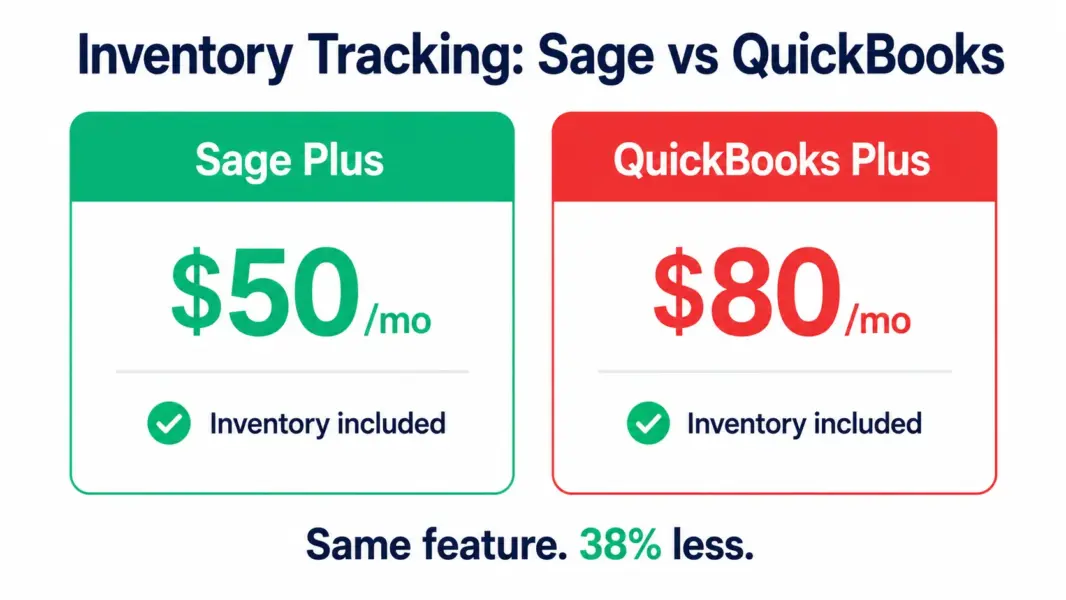
Accounting Plus (~$50 per month). Adds inventory management, multi-currency support, budgeting, and unlimited users. For product-based businesses, this plan competes directly with QuickBooks Online Plus at $80 per month, delivering similar inventory capability at roughly 60% of the price.
Sage frequently runs promotions offering the first few months free or at steep discount. Check the current offer before signing up at full price.
Where Sage Stands Out
Financial reporting is Sage’s strongest feature. From the dashboard, profit and loss, balance sheet, cash flow, aged receivables, and sales tax reports generate in seconds. According to Business News Daily, this was the most seamless reporting experience across all accounting platforms they tested. The reports export cleanly to PDF and Excel without reformatting headaches.
Inventory tracking on the Plus plan sets Sage apart on price. QuickBooks Online does not include inventory management until the Plus tier at $80 per month. Sage delivers comparable stock tracking, cost-of-goods-sold calculations, and inventory reporting at $50, saving $30 per month for product-based businesses.
Phone support is included on every Sage plan at no extra cost. QuickBooks restricts phone support to higher tiers. Wave offers email only on its free plan. For businesses that value picking up the phone and talking to a human about an accounting question, this is a real advantage.
Sage Copilot AI automates bank categorization, suggests transaction matches, and answers accounting questions in plain language. It is included on all plans with no additional fee, which differentiates Sage from competitors that charge for AI features or gate them to premium tiers.
Where Sage Falls Short
No time tracking or mileage tracking. Freelancers and consultants who bill by the hour or drive to client sites need FreshBooks or Harvest. This single gap makes Sage a poor fit for the freelance market.
The integration ecosystem is smaller than competitors. Sage connects to Stripe, PayPal, Shopify, and Salesforce, but the catalog is limited compared to Xero’s 1,000-plus apps or QuickBooks’ 750-plus. If your business depends on connecting accounting software to niche industry tools, verify Sage’s marketplace before committing.
The Start plan missing cash flow statements is an unusual omission for a paid accounting product. Cash flow is one of the most fundamental financial reports every business needs. Upgrading to Standard at $40 per month is the realistic minimum for proper bookkeeping.
How Sage Compares
Sage at $40 to $50 per month delivers inventory and reporting that QuickBooks charges $80 for. FreshBooks at $19 per month delivers time tracking and invoicing polish that Sage lacks. Wave at $0 delivers free invoicing and bookkeeping. QuickBooks at $30 per month delivers the deepest feature set and largest integration library.
Choose Sage if you sell products and need affordable inventory tracking with strong reporting. Choose FreshBooks if you are a freelancer billing by the hour. Choose Wave if budget is the priority and you need free accounting. Choose QuickBooks if you need the most complete feature set and broadest integration support. For the free alternative, see our Wave review. For the invoicing specialist, see our FreshBooks review.
Last updated: July 14, 2026
Frequently Asked Questions
How much does Sage Accounting cost in 2026?
Sage Accounting offers three cloud plans in the US: Start at approximately $20 per month, Standard at $40, and Plus at $50. Pricing varies by country and promotional offers. Sage frequently runs promotions with the first few months free or discounted. No free plan is available. Always check the official pricing page for current rates.
Is Sage Accounting good for freelancers?
No. Sage does not track billable hours or mileage, which freelancers who bill by the hour or drive to clients need. FreshBooks and Harvest are better fits for freelancers. Sage is designed for product-based and service businesses that invoice by project or product rather than by time.
Does Sage include inventory tracking?
Yes, on the Plus plan at approximately $50 per month. Sage tracks stock levels, cost-of-goods-sold, and generates inventory reports. QuickBooks Online does not include comparable inventory until its $80 per month Plus tier, making Sage roughly 40% cheaper for the same capability.
Is Sage the same as Sage 50 or Sage Intacct?
No. Sage Accounting is cloud software for small businesses. Sage 50 is desktop software for mid-market businesses starting around $30 per month per user. Sage Intacct is enterprise ERP starting at $15,000-plus per year. They are entirely separate products with separate pricing and separate interfaces.
Does Sage have phone support?
Yes, on all plans at no extra cost. This differentiates Sage from QuickBooks, which restricts phone support to higher tiers, and Wave, which offers email-only support on its free plan.
Is Sage cheaper than QuickBooks?
For inventory, yes. Sage Plus at $50 per month includes inventory that QuickBooks charges $80 for. For basic accounting, QuickBooks Simple Start at $30 per month offers more integrations and features than Sage Start at $20. The value comparison depends on whether you need inventory (Sage wins) or integrations (QuickBooks wins).
Related Accounting Guides
Sage Accounting does two things better than its competitors: financial reporting and inventory tracking. Reports generate in seconds with three clicks. Inventory is included from the Standard plan at $40 per month, where QuickBooks charges $80 for the same feature. Phone support on every plan is a genuine differentiator. The gaps are equally clear: no free plan, no time tracking, limited integrations, and a confusing product range where Sage Accounting, Sage 50, and Sage Intacct are entirely separate products. Product-based small businesses that need inventory and reporting depth at a fair price will find good value here. Freelancers and service businesses should look at FreshBooks or Wave instead.