Pros
- Most visual and customizable CRM interface with drag-and-drop pipelines and kanban boards
- Built on monday.com Work OS so CRM and project boards share one platform
- 150-plus pre-built templates for instant pipeline setup across industries
- Closed deals auto-spin into project boards bridging sales to operations seamlessly
- AI features expanding fast including AI Sales Agent and AI email composition in [current_year]
- 14-day free trial of Pro plan with no credit card required
- Cross-team visibility between sales, marketing, and delivery teams on one platform
Cons
- 3-seat minimum on all plans means solo users pay for 3 seats regardless
- Basic plan at $12 per seat has zero automations and no email sync making it a contact list not a CRM
- Standard plan at $17 per seat caps automations at 250 actions per month which runs out fast
- Real starting plan for a functional CRM is Pro at $28 per seat not the advertised $12
- Feature gating is aggressive with email sequences and forecasting locked to Pro and above
- Reporting depth trails dedicated CRMs like Salesforce and HubSpot Professional
- AI credits are usage-based with consumption rates not publicly documented
monday CRM advertises a $12 per seat starting price. Do not budget for that number. The Basic plan at $12 is a shared contact list – it has zero automations, no email sync, and no integrations. The plan most teams actually need is Pro at $28 per seat, which is where you get email sequences, sales forecasting, and enough automation to run a real pipeline. This monday CRM review evaluates the platform at Pro pricing because that is what you will pay.
Starting Price: $12/seat/mo Basic (annual, 3-seat min) | $28/seat/mo Pro (annual) | Free Plan: No | Free Trial: 14 days, no credit card
The Sales-to-Project Handoff Nobody Else Does
monday CRM’s most unique capability is not the pipeline view. It is the post-sale handoff. When a deal closes, it automatically spins up a project board for client onboarding, implementation, or delivery. The client data, deal notes, and agreed scope carry over without manual re-entry. Sales, account management, and delivery teams see the same information on the same platform.
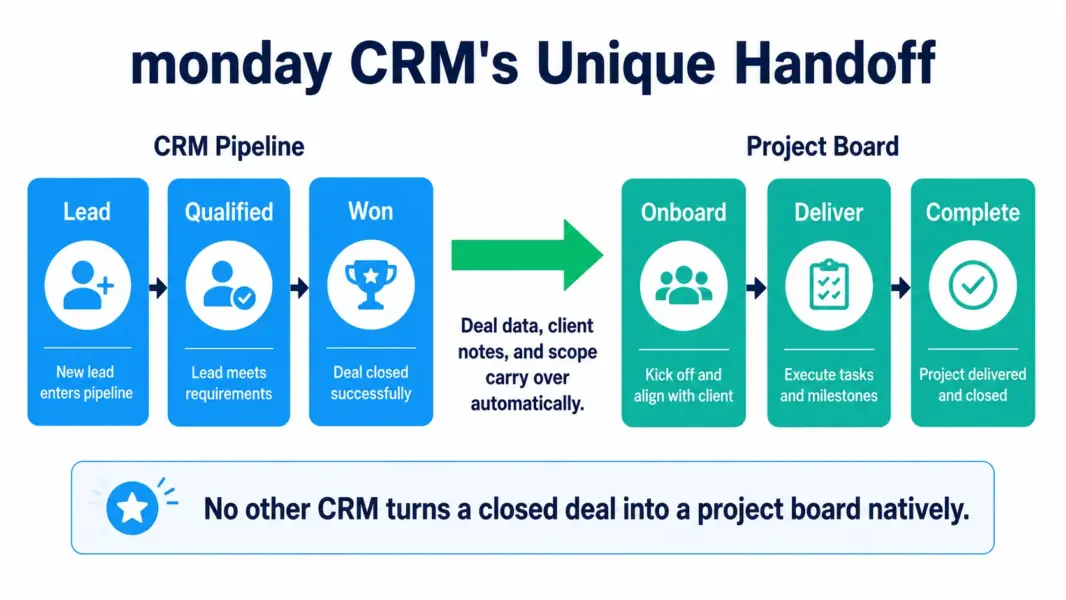
This matters for agencies, professional services firms, and any business where closing the deal is half the work and delivering it is the other half. On Pipedrive or Freshsales, a closed deal sits in the CRM. The delivery team uses a separate project tool. Handoff notes get lost. monday eliminates that gap because CRM and project management run on the same Work OS. According to CRM.org, few CRMs handle post-sale execution this cleanly.
The Visual Interface: Strength and Weakness
monday CRM is the most visually engaging CRM on the market. Color-coded pipelines, drag-and-drop deal stages, customizable columns, and dashboard widgets make pipeline management feel intuitive rather than administrative. The 150-plus pre-built templates get a first pipeline live in minutes. For teams where CRM adoption has historically failed because reps refused to use boring software, monday’s visual approach solves the adoption problem.
The weakness is the same flexibility. monday gives you unlimited customization freedom with minimal guardrails. You can build anything, which means you can also build a mess. Teams without a clear CRM architecture spend weeks reorganizing boards and pipelines. According to DecisionCircuit, the platform excels once you are past the initial build but requires planning to avoid structural sprawl, and CRM boards sitting next to project boards can confuse first-time users.
AI in 2026: Real Features, Opaque Pricing
monday CRM added AI aggressively in 2026. AI Sales Agent identifies and qualifies leads. AI Lead Agent routes inbound leads based on scoring. AI email composition drafts context-aware replies. Column autofill enriches contact data automatically. Sentiment analysis flags deal risks from communication tone. An AI Notetaker summarizes calls and suggests next steps.
The concern is pricing. AI features consume credits, and the credit consumption rate per action is not publicly documented as of 2026. You can buy additional credits, but there is no published price-per-credit table. According to SaaS CRM Review, you should ask the sales rep for a written credit-consumption table before signing a multi-year deal and avoid building forecasting workflows that depend on credits you cannot price.
What Each Plan Actually Gives You
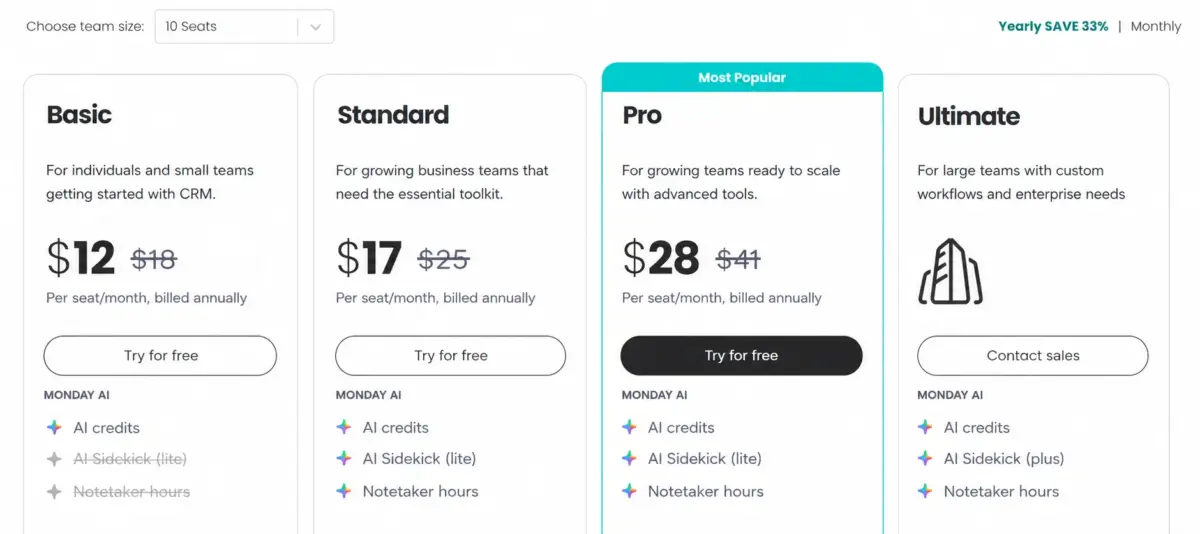
Basic ($12/seat, annual). Unlimited contacts, pipelines, and boards. Web forms. Basic templates. No email sync, no automations, no integrations, no dashboards. Useful only as a digital contact list. Not a functional CRM.
Standard ($17/seat, annual). Adds two-way Gmail and Outlook sync, duplicate merge, basic dashboards, and 250 automation and integration actions per month across all users. The 250 cap is shared: if 5 users trigger 50 automations each in a month, the limit is reached. Adequate for very small teams with simple pipelines.
Pro ($28/seat, annual). Adds email sequences, email tracking, quotes and invoices, sales forecasting, AI features, time tracking, custom formulas, and 25,000 automation actions per month. This is the real CRM plan. According to every independent 2026 review, Pro is the plan most sales teams need and the one to budget for.
Ultimate (custom pricing). Adds advanced analytics, 250,000 automation actions, 1TB storage, and dedicated customer success management. Required for enterprise-scale operations.
Who Should Choose monday CRM
Service businesses and agencies where the sales-to-delivery handoff is critical. Teams of 8 to 75 people that want visual pipeline management with minimal training. Organizations already using monday.com for project management that want CRM on the same platform. Teams that have failed to adopt traditional CRMs because of boring interfaces.
Who Should Choose Pipedrive, Freshsales, or HubSpot Instead
Solo founders and teams under 3 people, since the 3-seat minimum means paying for unused seats. Outbound sales teams that need a built-in phone dialer, which monday CRM lacks (Freshsales includes one natively). Teams that need deep sales-specific reporting and forecasting beyond what monday’s dashboards provide. Budget-conscious teams where Pipedrive at $14 per seat or Freshsales at $9 deliver pipeline management without the $28 Pro requirement. For the full comparison, see our Freshsales vs Pipedrive comparison and best CRM for startups guide.
Try monday CRM Free for 14 Days
Last updated: July 14, 2026
Frequently Asked Questions
How much does monday CRM cost in 2026?
monday CRM has four plans billed annually: Basic at $12 per seat, Standard at $17, Pro at $28, and Ultimate at custom pricing. All plans have a 3-seat minimum. Monthly billing runs roughly 46 to 50% higher than annual rates. The realistic starting plan for a functional CRM is Pro at $28 per seat because Basic lacks automations and email sync.
Does monday CRM have a free plan?
No. monday.com Work Management has a free plan but the CRM product does not. The CRM offers a 14-day free trial of the Pro plan with no credit card required. After the trial, you must select a paid plan starting at $12 per seat per month with a 3-seat minimum ($36 per month minimum commitment).
Is monday CRM Basic worth it?
No for most teams. Basic at $12 per seat includes zero automations, no email sync, no integrations, and no dashboards. It functions as a shared contact list, not a CRM. Standard at $17 adds email sync but caps automations at 250 per month. Most teams need Pro at $28 for email sequences, forecasting, and meaningful automation capacity.
What makes monday CRM different from Pipedrive or HubSpot?
monday CRM is built on the monday.com Work OS platform, which means CRM and project management share the same system. A closed deal can automatically become a project board for delivery. This sales-to-operations handoff is unique to monday and valuable for agencies and service businesses. Pipedrive and HubSpot require separate project management tools for post-sale execution.
Is monday CRM good for small teams?
monday CRM works well for teams of 5 to 15 people on the Pro plan. The 3-seat minimum means very small teams pay for unused seats. Solo founders and 2-person teams get better value from Pipedrive ($14 per seat, no minimum) or Freshsales ($9 per seat with a free plan for up to 3 users).
Does monday CRM include a phone dialer?
No. monday CRM does not include a built-in phone dialer. Outbound teams that make heavy call volumes need to integrate a third-party calling tool like Aircall or JustCall, adding $25 to $40 per user per month on top of the CRM subscription. Freshsales includes a built-in dialer natively starting at $9 per user.
Related CRM Guides
monday Sales CRM is the most visually engaging CRM available and the only one where a closed deal automatically becomes a project board for delivery. That sales-to-operations handoff is genuinely unique and valuable for service businesses and agencies where post-sale execution matters as much as closing. The trap is the entry pricing. Basic at $12 per seat is a shared contact list with no automations or email sync. Standard at $17 adds email sync but caps automations at 250 per month. The realistic starting plan for a functional CRM is Pro at $28 per seat, which unlocks email sequences, forecasting, quotes, and 25,000 monthly automations. Budget for Pro, not Basic, when evaluating monday CRM against Pipedrive, Freshsales, and HubSpot.