The Zoho CRM vs HubSpot decision is dominated by one number most comparison articles bury: HubSpot’s price cliff. HubSpot Starter costs $20 per seat per month. HubSpot Professional jumps to $890 per month base, plus a mandatory $3,000 onboarding fee. For a 5-person team, Zoho CRM Professional costs $1,380 per year. The same team on HubSpot Professional costs over $25,000 in year one. That 18:1 cost ratio is the most important fact in this comparison, and everything else follows from it.
The Price Cliff: The Fact That Changes Everything
HubSpot’s pricing looks competitive at the entry level. The free CRM supports unlimited users with up to 1 million contacts, which is the most generous free CRM tier available. Starter at $20 per seat feels reasonable. The cliff arrives at Professional, where the base jumps to $890 per month (including 3 seats) with each additional seat adding $100 per month, plus a one-time mandatory onboarding fee of $3,000.
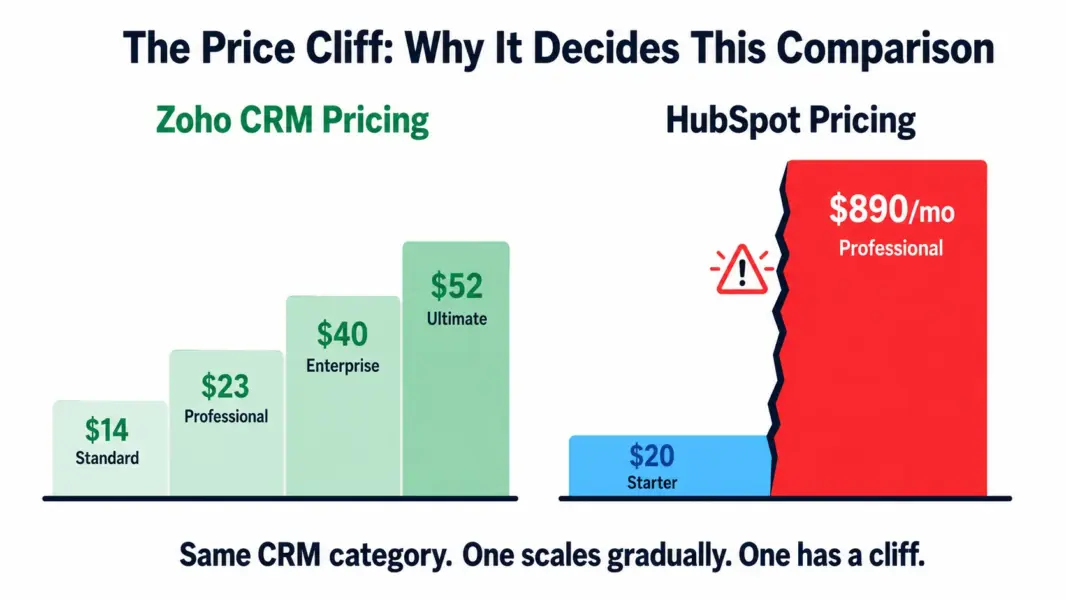
Zoho CRM scales gradually: Standard at $14, Professional at $23, Enterprise at $40, Ultimate at $52 per user per month. No mandatory onboarding fees, no base-plus-seat pricing, no price cliffs. According to a comparison published by Lovable in 2026, a 5-person team needing advanced features pays $115 per month on Zoho Professional versus approximately $1,900 per month on HubSpot Professional before the onboarding fee.
| Tier | Zoho CRM | HubSpot |
|---|---|---|
| Free | 3 users, basic CRM | Unlimited users, 1M contacts (best free CRM) |
| Entry paid | $14/user (Standard) | $20/seat (Starter) |
| Mid tier | $23/user (Professional) | $890/mo base + $100/seat (Professional) |
| Enterprise | $40/user (Enterprise) | $3,600/mo base (Enterprise) |
| 5-user annual cost (mid tier) | $1,380 | $25,800+ (incl. onboarding) |
Where HubSpot Justifies Its Premium
HubSpot is not overpriced for the teams it serves well. Its value lies in three areas that Zoho does not match. Understanding these prevents choosing Zoho when HubSpot’s premium actually pays off.
Ease of use is genuinely better. HubSpot consistently scores higher on ease of use across G2, Capterra, and TechRadar reviews. Teams achieve basic proficiency within one week. Zoho requires two to four weeks of configuration for full capability. For organizations without a dedicated CRM administrator, HubSpot’s faster time-to-productivity can justify the cost difference in saved onboarding time.
Marketing-sales alignment is unified. HubSpot connects Marketing Hub, Sales Hub, and Service Hub on a shared contact record. Leads flow from first website visit through closed deal without integration work. Zoho separates marketing into Zoho Campaigns, a distinct product requiring separate licensing. For marketing-led teams where lead flow from content to pipeline matters most, HubSpot’s unified approach eliminates the integration overhead Zoho requires.
HubSpot Academy and community depth. HubSpot’s educational resources, certifications, and community support are best-in-class. For teams learning inbound marketing alongside CRM adoption, this ecosystem accelerates skill development in ways Zoho’s documentation does not match.
Where Zoho CRM Wins Decisively
Zoho CRM’s advantages are equally clear, centered on cost, customization, and ecosystem breadth at the application level.
Deep customization at a fraction of the cost. Zoho offers configurable fields, custom modules, custom buttons, Blueprint workflow automation, tab grouping, and picklist history tracking from the Standard tier. HubSpot gates custom objects to Enterprise ($3,600 per month) with a limit of 10 custom modules. For businesses with unique sales processes that need CRM tailored to their workflow, Zoho’s customization depth at $14 to $40 per user is dramatically more accessible.
The Zoho ecosystem covers 45-plus apps. Zoho natively owns applications spanning CRM, email, project management, invoicing, analytics, HR, and more. For organizations that adopt multiple Zoho tools, the data sharing and reduced integration overhead compound savings. Zoho One at $45 per user per month gives access to the entire 45-plus app suite, which is less than a single seat on HubSpot Professional.
AI features included at lower tiers. Zoho CRM includes Zia AI for lead assignment and scoring from the Enterprise tier at $40 per user. HubSpot’s comparable Breeze AI features require paid add-ons at $30 per user on top of already-premium tier pricing.
Who Should Choose Which?
| Choose HubSpot If | Choose Zoho CRM If |
|---|---|
| Your team needs the fastest CRM adoption possible | Budget matters and you need predictable per-user scaling |
| Marketing-to-sales lead flow is your core need | Your sales process requires deep customization |
| You can absorb the Professional tier price cliff | You want CRM plus 45-plus apps in one ecosystem |
| You value HubSpot Academy for team training | You have technical capacity to configure workflows |
| Your free plan needs exceed Zoho’s 3-user limit | You need custom modules without Enterprise pricing |
| You run an inbound marketing operation | You run an outbound or mixed sales operation |
For more CRM options, see our best free CRM tools guide covering platforms from both ecosystems, or our best CRM for startups guide matching tools to funding stages. For a broader comparison, see the Freshsales vs Pipedrive comparison covering sales-focused CRM alternatives.
Final Verdict
HubSpot is the right CRM for marketing-led teams that value ease of use, unified marketing-sales data, and world-class onboarding resources, and can absorb the price cliff when they outgrow the free tier. Zoho CRM is the right CRM for budget-conscious teams that need deep customization, gradual pricing that scales predictably, and a broad application ecosystem at a fraction of HubSpot’s cost. The price cliff is the deciding factor: if $890 per month for Professional is within your budget, HubSpot delivers a premium experience worth paying for. If it is not, Zoho delivers comparable CRM capability at 5-18% of the cost.
Last updated: July 6, 2026
Frequently Asked Questions
Is Zoho CRM cheaper than HubSpot in 2026?
Yes, significantly. Zoho CRM scales from $14 to $52 per user per month with no mandatory fees. HubSpot jumps from $20 per seat (Starter) to $890 per month base (Professional) with a $3,000 onboarding fee. A 5-person team pays $1,380 per year on Zoho Professional versus over $25,000 in year one on HubSpot Professional, an 18:1 cost ratio.
Is HubSpot easier to use than Zoho CRM?
Yes. HubSpot consistently scores higher on ease of use across G2 and Capterra. Teams achieve basic proficiency within one week, while Zoho requires two to four weeks of configuration. HubSpot’s interface is designed for fast adoption with minimal training, while Zoho’s depth of options creates a steeper learning curve for non-technical users.
Does HubSpot have a free CRM?
Yes. HubSpot’s free CRM is the most generous in the category, supporting unlimited users and up to 1 million contacts with contact management, deal tracking, email tracking, and live chat. It is genuinely usable for small teams and significantly more generous than Zoho’s free plan, which caps at 3 users.
What is HubSpot’s price cliff?
HubSpot’s Starter plan costs $20 per seat per month. The Professional plan jumps to $890 per month base (including 3 seats) with each additional seat at $100 per month, plus a mandatory $3,000 one-time onboarding fee. This jump from $20 to $890 is the steepest price cliff in CRM software and the single most important factor in the Zoho vs HubSpot decision.
Is Zoho CRM hard to set up?
Zoho CRM has a steeper initial setup than HubSpot, typically requiring two to four weeks of configuration for full capability. The depth of customization options that makes Zoho powerful also creates complexity for non-technical teams. Organizations without a dedicated CRM administrator may find the setup process challenging compared to HubSpot’s faster out-of-the-box deployment.
Can I start free and switch later?
Yes. Both offer free plans you can start with today. HubSpot’s free plan is more generous (unlimited users, 1M contacts) versus Zoho’s (3 users). Starting free lets you evaluate both platforms with real data before committing to paid tiers. Migration between them is possible but costs 1-2 weeks of effort for data transfer, automation rebuilding, and team retraining.
Which CRM has better AI features?
Both have invested in AI. HubSpot’s Breeze AI drafts emails, summarizes meetings, and identifies leads, but is a paid add-on at $30 per user. Zoho’s Zia AI handles lead scoring and assignment from the Enterprise tier at $40 per user. HubSpot’s AI is more accessible in the interface; Zoho’s is included at a lower total cost. Neither matches Salesforce Einstein for enterprise AI depth.
Related CRM Comparisons and Guides
- Freshsales vs Pipedrive 2026
- Best Free CRM Tools
- Best CRM for Startups
- Complete Guide to CRM Software