
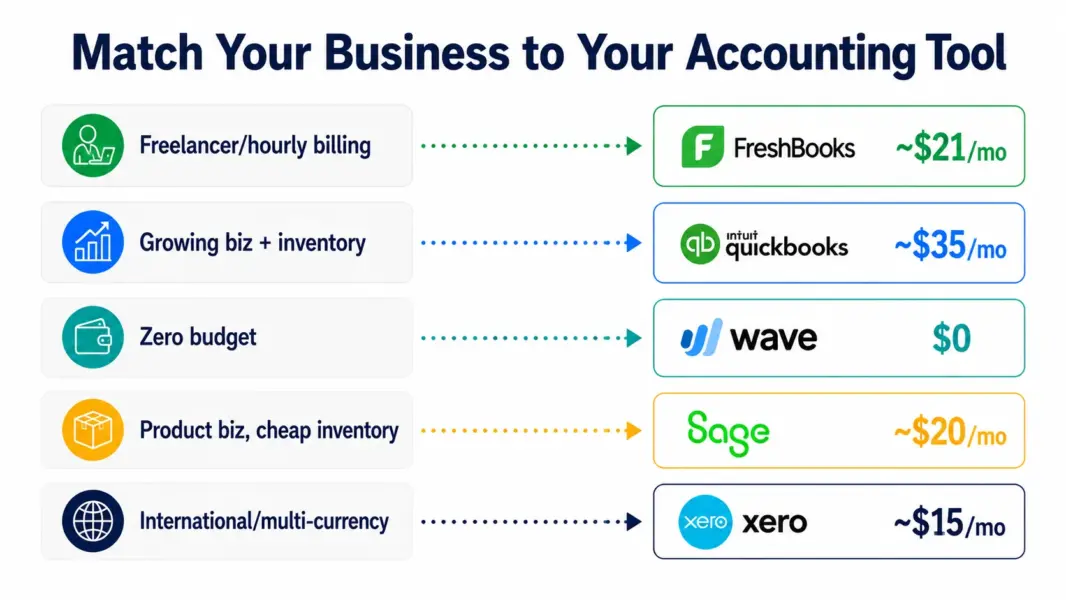
Stop comparing feature checklists. The best accounting software is the one that matches how your business makes money. A freelancer billing clients by the hour needs different software than a retailer tracking inventory. A solopreneur watching every dollar needs different software than a 20-person company with a dedicated bookkeeper. This guide matches 5 platforms to the businesses they actually serve.
Freelancer Billing by the Hour: FreshBooks
FreshBooks was built for people who invoice clients, not people who do bookkeeping. Time tracking on every plan. Polished invoice templates. One-click estimate-to-invoice conversion. Client portal where customers view and pay invoices online. If you bill by the hour and your biggest accounting need is getting paid faster, FreshBooks does that job better than anything else.
Lite starts around $21 per month for 5 billable clients. Plus around $37 for 50. The client cap is the upgrade trigger to watch. Most freelancers outgrow Lite within 6 months. No free plan, but a 30-day trial needs no credit card. See our FreshBooks review for the full analysis.
Growing Business With Inventory or Employees: QuickBooks Online
Your accountant already knows QuickBooks. That alone keeps 7 million US businesses on the platform. But the real reason is depth: double-entry accounting, inventory tracking, 1099 contractor management, payroll integration, and 750-plus app connections. No other tool at this price gives you all of that.
Simple Start costs roughly $35 per month. Plus (with inventory) roughly $115. QuickBooks has raised prices 12 to 17% annually since 2023, so check the official page before committing. If you sell products, manage employees, or need your accountant to access your books, QuickBooks is the standard for a reason. See our QuickBooks vs FreshBooks comparison for the head-to-head.
Zero Budget, Need Real Accounting: Wave
Wave’s free plan is remarkable. Unlimited invoicing, expense tracking, double-entry bookkeeping, and basic financial reporting at $0 per month. Not a trial. Not a teaser. Genuinely free forever. Over 2 million small businesses run on Wave’s free plan.
The limits are real: no inventory, manual bank imports on free, email-only support, no multi-currency. Pro at $19 per month adds automated bank feeds and receipt scanning. Wave works until your business complexity outgrows it, then you migrate to QuickBooks or Xero. See our Wave review for when free stops being enough.
Product Business Wanting Affordable Inventory: Sage Accounting
Sage includes inventory tracking from the Standard plan at roughly $40 per month. QuickBooks doesn’t include inventory until the $115 Plus plan. For product-based businesses where inventory is essential and budget matters, Sage delivers the same capability at roughly 60% less. Phone support on every plan is a genuine bonus.
The gaps: no time tracking, limited integrations, confusing product range (Sage Accounting, Sage 50, and Sage Intacct are separate products). See our Sage review for the full breakdown.
International Business Needing Multi-Currency: Xero
Xero handles multi-currency invoicing and reporting natively from the Standard plan. If you bill clients in USD, EUR, GBP, and AUD, Xero manages exchange rates, currency conversion, and multi-currency financial statements without workarounds. Wave and FreshBooks don’t support multi-currency. QuickBooks adds it on higher tiers at more cost.
Xero starts around $15 per month (Starter, limited invoices). Growing plan around $42. Established around $78. The Starter plan’s invoice limits push most businesses to Growing quickly. Xero integrates with 1,000-plus apps, making it the broadest integration ecosystem after QuickBooks.
How to Choose in 30 Seconds
Bill clients by the hour, no inventory → FreshBooks. Sell products, have employees, need accountant access → QuickBooks. Zero budget, basic accounting → Wave. Need inventory cheaper than QuickBooks → Sage. Invoice internationally in multiple currencies → Xero. If none of these fit exactly, start with Wave (free) and upgrade when you hit a specific limit that creates workarounds.
FreshBooks or QuickBooks?
Most small businesses narrow it to these two. Our comparison breaks down the exact decision.
Last updated: July 24, 2026
Frequently Asked Questions
What is the best accounting software for small business in 2026?
QuickBooks Online is the best overall for growing businesses with inventory, employees, and accountant needs. FreshBooks is best for freelancers and service businesses prioritizing invoicing. Wave is the best free option. The right choice depends on your business type and whether you need inventory, time tracking, or multi-currency support.
What is the cheapest accounting software?
Wave is free forever with unlimited invoicing and double-entry bookkeeping. Among paid options, Xero Starter costs roughly $15 per month. FreshBooks Lite costs roughly $21. Sage Accounting Start costs roughly $20. QuickBooks Simple Start costs roughly $35. All run frequent promotions so check official pages for current rates.
Is FreshBooks or QuickBooks better?
FreshBooks is better for freelancers who bill by the hour and prioritize invoicing simplicity at a lower price. QuickBooks is better for businesses with inventory, employees, or complex accounting needs that require accountant access and advanced reporting. See our full comparison for the detailed breakdown.
Do I need accounting software or just a spreadsheet?
If you have fewer than 20 transactions per month and no employees, a spreadsheet works. Once you exceed that, accounting software saves time on categorization, invoicing, and tax preparation that spreadsheets can’t automate. Wave is free, so there’s no cost barrier to upgrading from a spreadsheet.
Can I switch accounting software later?
Yes, but migration takes 1 to 2 weeks. You export your data (contacts, invoices, transactions) and import it into the new platform. Some manual mapping is required because platforms structure data differently. Don’t switch mid-tax-year. Plan migrations for January or July when your accountant is least busy.
Does my accountant need to use the same software I do?
Most US accountants know QuickBooks and prefer working in it. Many also support Xero. Fewer work in FreshBooks or Wave. If accountant collaboration is important, QuickBooks is the safest choice. Ask your accountant what they support before choosing a platform.
Related Accounting Guides
