The Intercom vs Zendesk comparison in 2026 has a new dimension most guides skip: AI resolution pricing. Both platforms now charge per AI-resolved conversation on top of seat-based plans, and the gap between Intercom’s $0.99 per resolution and Zendesk’s $1.50 to $2.00 creates a cost difference that compounds dramatically at scale. This comparison covers the philosophical split (conversation-first versus ticket-first), the seat pricing, and the AI economics that increasingly determine your real support budget.
The Philosophical Split: Conversations vs Tickets
Zendesk treats every customer interaction as a ticket with a unique ID that moves through defined stages (open, pending, solved) with customizable workflows, escalation paths, and SLA tracking. This structured approach works for support teams handling high volumes with complex, multi-touch cases that require tracking, assignment rules, and accountability across agents.
Intercom treats customer interactions as ongoing conversations in a unified inbox, closer to messaging a colleague than filing a support case. This conversational approach works for SaaS teams and product-led companies where most support happens through in-app chat and resolves in one or two messages. According to a 2026 review by ClearFeed, the right rule of thumb is: if your average resolution takes 1-2 messages and happens inside your product, Intercom fits. If your average case needs 3-plus touches across channels and agents, Zendesk fits.
Seat Pricing: Zendesk Has Lower Entry, Intercom Costs More Per Seat
Zendesk’s entry pricing is lower per agent, but both tools have complex tier structures with significant feature gating across levels.
| Tier | Intercom | Zendesk |
|---|---|---|
| Entry | Essential: $39/seat/mo | Support Team: $19/agent/mo |
| Mid | Advanced: $99/seat/mo | Suite Professional: $115/agent/mo |
| Enterprise | Expert: $139/seat/mo | Suite Enterprise: $169/agent/mo |
| AI agent cost | Fin: $0.99/resolution | $1.50 (committed) or $2.00 (pay-as-you-go)/resolution |
| 20-agent monthly (mid tier) | ~$1,980 + AI | ~$2,300 + AI |
At entry level, Zendesk is cheaper ($19 vs $39 per seat). At mid tier, the gap narrows. At enterprise, pricing is comparable. The wild card is AI resolution fees, which add a variable cost layer that both vendors introduced in the past year and that makes total spend dependent on support volume rather than headcount alone.
The AI Resolution War: $0.99 vs $2.00 Per Conversation
The AI pricing model is the emerging story of this comparison. Both platforms now offer AI agents that resolve customer conversations autonomously, and both charge per successful resolution on top of seat subscriptions. Intercom’s Fin charges $0.99 per resolution. Zendesk charges $1.50 (committed volume) or $2.00 (pay-as-you-go) per resolution.
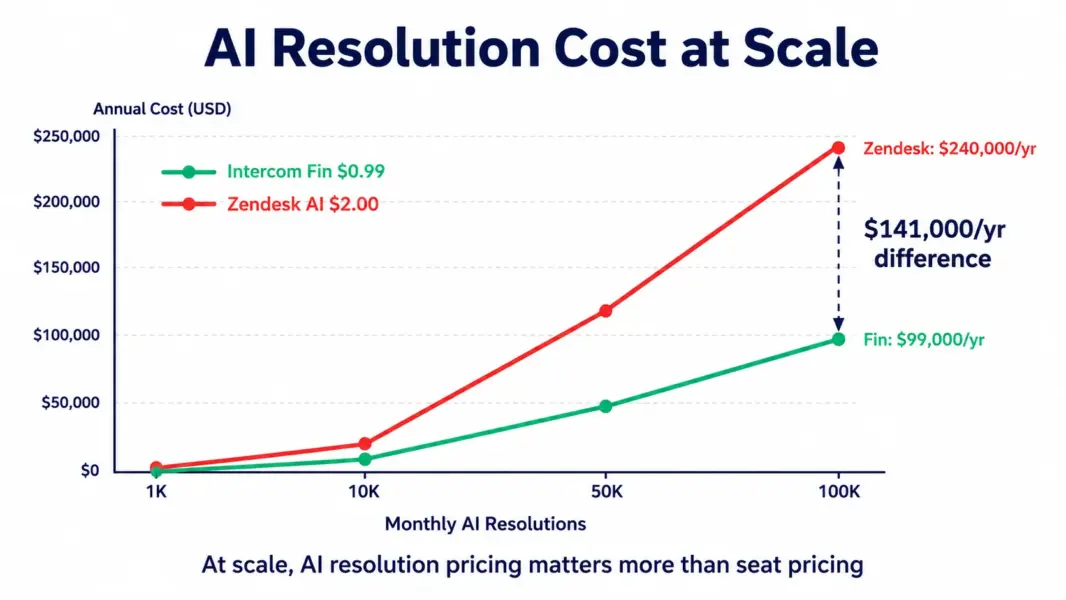
The math compounds fast. At 10,000 monthly AI resolutions, Intercom’s Fin costs $9,900 versus Zendesk’s $15,000 to $20,000, a $5,100 to $10,100 annual difference. At 100,000 monthly resolutions, the gap reaches $60,000 to $120,000 per year. For support teams investing heavily in AI deflection, this pricing difference is potentially the single largest cost factor in the comparison.
Intercom’s Fin reports autonomous resolution rates of 50 to 67% of incoming conversations. Zendesk’s AI agents focus more on agent assistance (suggesting replies, summarizing threads, triaging tickets) with autonomous resolution growing but less mature. According to independent testing cited in a 2026 analysis by HelpCrunch, Fin outperformed Zendesk AI in accuracy, completeness, and resolution quality in head-to-head tests. However, Intercom’s model charges for “resolved” conversations even when the customer simply leaves, which can inflate costs on ambiguous outcomes.
Ticketing and Workflows: Zendesk’s Depth Remains Superior
For structured ticketing with complex workflows, Zendesk remains the stronger platform. Custom ticket fields, macros, triggers, multi-step automations, SLA policies, and skills-based routing give enterprise support teams the operational control they need for high-volume, multi-channel support.
Intercom has invested in ticketing features, adding Tracker (for recurring issues) and back-office tickets for internal tasks in 2026, but the implementation still feels lighter than Zendesk’s. Intercom excels at hiding complexity behind a conversational interface, which is a strength for customer experience but a limitation for support operations teams that need granular control over queue management and escalation paths.
Ecosystem and Scale: Zendesk’s Enterprise Footprint
Zendesk serves over 200,000 enterprise customers with 1,800-plus integrations and acquired Forethought (March 2026) to strengthen AI capabilities. The platform’s breadth across email, phone, social, and chat makes it the standard for enterprises that need unified support across every channel.
Intercom serves a strong SaaS and technology customer base with a focused integration ecosystem. Intercom’s Messenger supports product tours, in-app messages, carousels, and custom bots that Zendesk’s messaging does not match for product-led engagement. One significant development to note: Salesforce announced intent to acquire Intercom for approximately $3.6 billion in June 2026, which could reshape the platform’s roadmap and pricing.
Who Should Choose Which?
| Choose Intercom If | Choose Zendesk If |
|---|---|
| Support primarily happens through in-app chat | Support spans email, phone, social, and chat |
| Most conversations resolve in 1-2 messages | Cases require 3-plus touches across agents |
| You are a SaaS or product-led company | You are a large enterprise with complex SLAs |
| You want the cheapest AI resolution pricing | You need structured ticketing and routing |
| Proactive in-app messaging matters | You need 1,800-plus integrations and compliance |
| Your team is 5-50 agents | Your team is 50-plus agents with formal operations |
Final Verdict
Intercom wins for SaaS and product-led teams that handle support through in-app chat and want the most cost-effective AI resolution pricing. Fin AI at $0.99 per resolution delivers genuine autonomous support at half the cost of Zendesk’s AI. Zendesk wins for enterprises running high-volume, multi-channel support with complex SLAs, structured ticketing, and the operational depth that scaled support teams require. The AI resolution pricing war makes the cost difference larger than seat pricing alone suggests, so model your AI volume before deciding.
Last updated: July 7, 2026
Frequently Asked Questions
Is Intercom cheaper than Zendesk in 2026?
Intercom’s entry seat price ($39) is higher than Zendesk’s ($19), but Intercom’s AI resolution pricing ($0.99 per resolution) is roughly half of Zendesk’s ($1.50-2.00). For teams investing heavily in AI-driven support, Intercom can be cheaper overall despite higher seat costs. A 20-agent team on Intercom Advanced costs roughly $1,980 per month versus $2,300 on Zendesk Professional, before AI fees.
What is AI resolution pricing?
AI resolution pricing is a per-conversation charge that both Intercom and Zendesk apply when their AI agents resolve customer conversations autonomously. Intercom’s Fin charges $0.99 per successful resolution. Zendesk charges $1.50 (committed) or $2.00 (pay-as-you-go). This usage-based cost adds a variable layer on top of fixed seat subscriptions, making total spend dependent on support volume.
Which AI is better, Intercom Fin or Zendesk AI?
Intercom’s Fin generally leads on autonomous resolution rates (50-67% of conversations resolved without human intervention) and costs less per resolution ($0.99 vs $1.50-2.00). Zendesk’s AI focuses more on agent assistance (suggesting replies, summarizing threads, sentiment analysis) with growing autonomous capability. Fin is better for hands-off resolution; Zendesk AI is better for augmenting human agents.
Is Zendesk better for large teams?
Yes. Zendesk serves over 200,000 enterprise customers and provides the structured ticketing, SLA management, skills-based routing, and multi-channel depth that large support organizations require. For teams of 50-plus agents with formal operational processes, Zendesk’s enterprise infrastructure is more robust than Intercom’s conversational approach.
Is Intercom being acquired by Salesforce?
Salesforce announced intent to acquire Intercom for approximately $3.6 billion in June 2026. The deal is expected to close around Q4 of Salesforce’s fiscal year. This could affect Intercom’s roadmap, pricing, and independence, so teams evaluating Intercom should monitor the acquisition’s progress and any resulting product changes.
Which is better for SaaS companies?
Intercom is generally better for SaaS companies because its Messenger supports in-app chat, product tours, proactive messaging, and custom bots that integrate support into the product experience. Zendesk can serve SaaS companies but its ticket-centric design feels more like a traditional helpdesk than a native product support channel.
Can I use Intercom Fin on top of Zendesk?
Yes. Intercom’s Fin can be deployed on an existing Zendesk instance via API, resolving conversations at $0.99 per resolution without requiring a full platform migration. This allows teams to test outcome-based AI without switching their helpdesk. The hybrid approach lets you compare Fin’s resolution performance against Zendesk’s native AI directly.
Related Help Desk Comparisons and Guides